Guides
Numbered Cards Explained: What /99, /25 and 1/1 Mean
Numbered cards explained with real 2026 Topps examples. What /25, /10 and 1/1 mean, where the print run is printed and why odds sheets never show it.
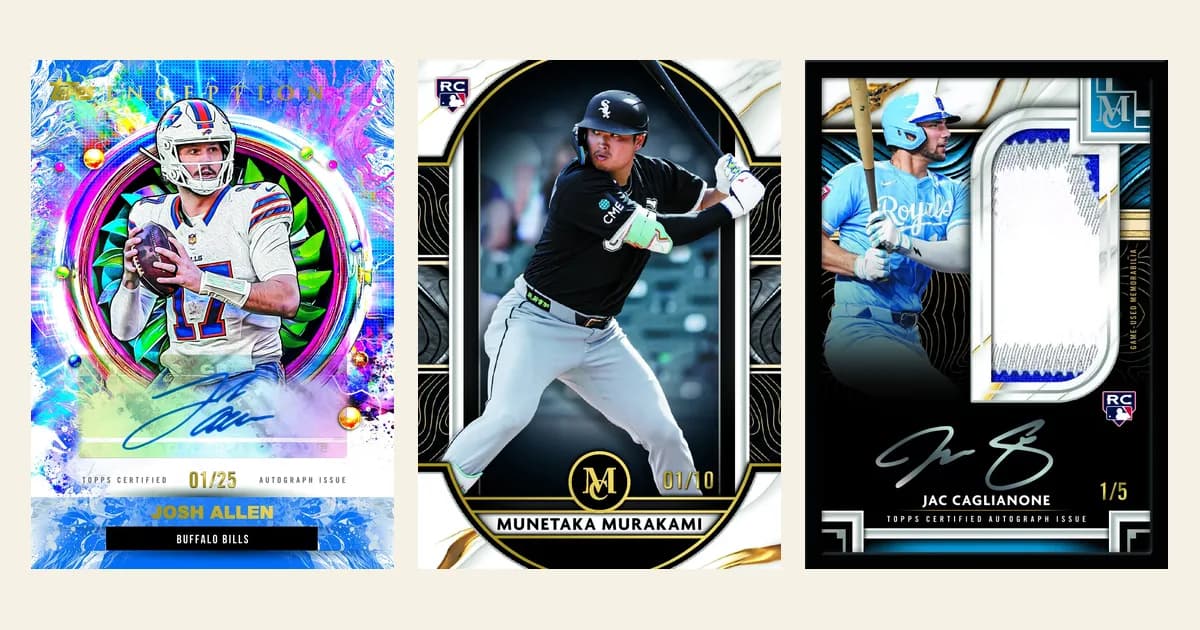
Numbered cards carry their print run on the card: 01/25 means copy one of 25. Here is how the numbering works on 2026 Topps products, where to find the run for a parallel you are chasing, and what the odds sheet can and cannot tell you. Examples come from Topps' own cards and guides.
TL;DR: A numbered card shows "copy/total" on the front or back (Topps Ripped). 1/1 is the rarest, one copy only. Topps' 2026 checklists and odds sheets do not print the /N; the card and Topps' box and collector guides do. The odds sheet gives a ratio per box format instead, for example 1:10,923 hobby for the one-of-one Update Series Foilfractor.
PATCH: Updated Oct 10, 2026: re-checked every Topps page, PDF and Reddit quote cited below.
What are numbered cards? (quick answer)
Numbered cards are short-printed cards with the print run stamped on them. Topps Ripped's glossary says "the print run is specified on either the front or back of the card," and gives the example of a card "sequentially numbered 10/100 to indicate that it is the 10th card out of a print run of 100."
Key Takeaways
- Format: copy number / print run, on the front or back of the card.
- 1/1: one copy exists. Superfractors, printing plates and cut signatures are common one-of-ones.
- Where to find the run: the card and Topps' guides on Topps Ripped. 2026 Topps checklists and odds sheets list no /N.
- Odds: the odds sheet gives a ratio per box format, not a print run.
- Jersey numbers: some parallels are numbered to the player's uniform number.
- Data, not advice: a print run tells you how many exist, not what one is worth.
Overview: how serial numbering works
Most products have a base set and "a smaller number of more-limited parallel cards," in Topps Ripped's words, versions that "run parallel" to the base set. Some parallels are unnumbered. The ones that carry a stamped number are numbered cards, and Topps Ripped puts them under short prints: "Numbered cards are short-printed (e.g. limited edition)."
Refractors are where most numbering lives. Topps Ripped says each refractor color "is printed to a different quantity, and they tend to be numbered." The 2026 Topps Chrome box guide shows how that plays out across formats: Jumbo has "numbered Blue, Green, Purple, Gold, Orange, Black, and Red" Wave Refractors, Mega has numbered X-Fractors from Aqua to Black, and the Delight box goes down to "a Tie-Dye Geometric Refractor numbered to two."
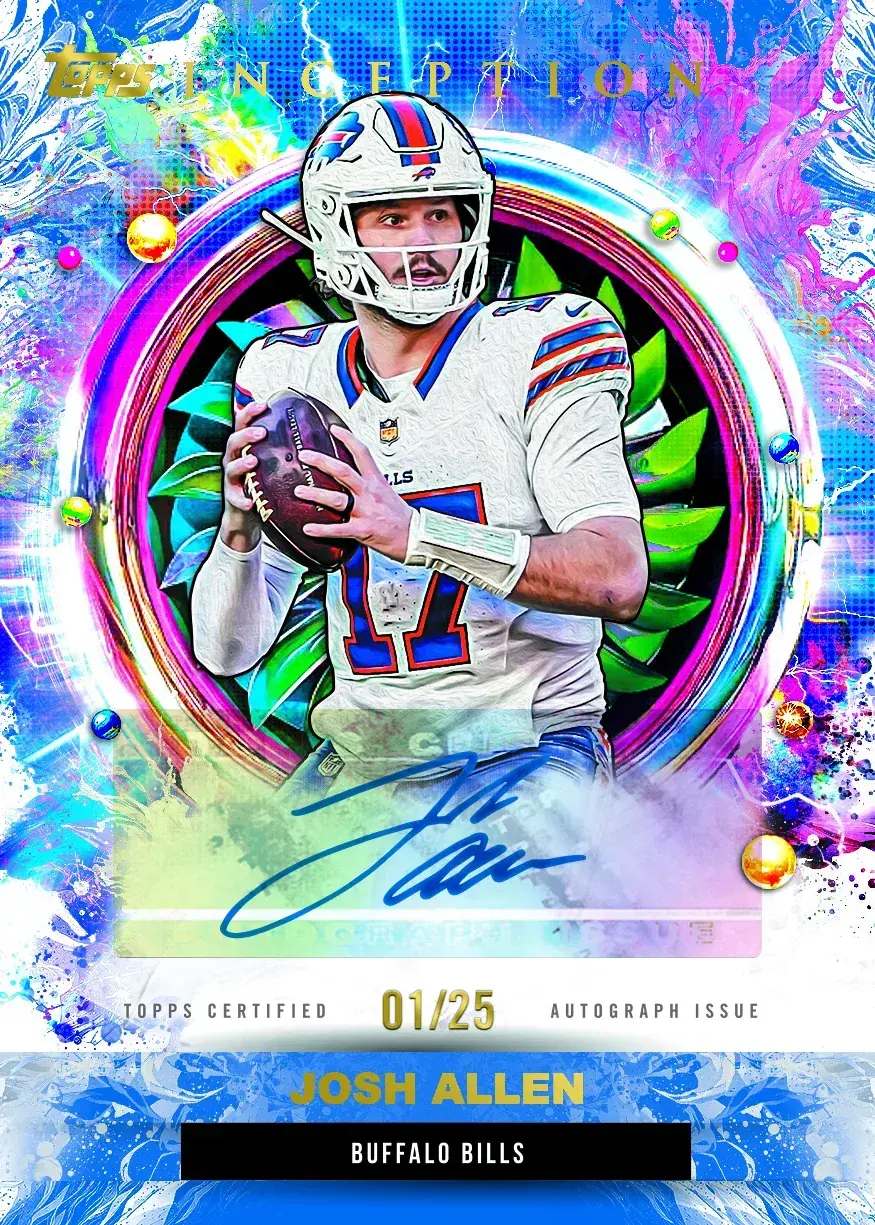 Card image: Topps (Topps Ripped Inception Football guide)
The Josh Allen Inception autograph above shows a common layout on a Topps autograph: the serial number is printed in gold between "Topps Certified" and "Autograph Issue," and reads 01/25.
Analysis: reading /25, /10, /5 and 1/1 on 2026 Topps cards
The second number is the run. The first is which copy you hold. A 01/25 and a 25/25 are the same card in the same parallel; the first number only identifies the copy. Collectors sometimes pay attention to it anyway, as the jersey-number section below shows.
| Print run | 2026 Topps example | What Topps says |
|---|---|---|
| /50 | Inception Football Gold Electricity parallel | "capped at 50 copies" |
| /35 | Inception Football Hot Pink parallel | "numbered to 35 copies" |
| /25 | Josh Allen Inception autograph (shown above) | printed "01/25" on the card |
| /15 | Bryce Harper Museum Silver Frame autograph | "numbered to just 15 copies" |
| /10 | Allen & Ginter Full-Size Autographs, Red Ink | "limited to 10 copies of each card" |
| /5 | Jac Caglianone Museum Black Frame patch auto | "numbered to just 5 copies" |
| /2 | Topps Chrome Tie-Dye Geometric Refractor | "numbered to two" |
| 1/1 | Allen & Ginter Cut Signatures (51 cards) | "Each of the 51 Cut Signature cards is a one-of-one" |
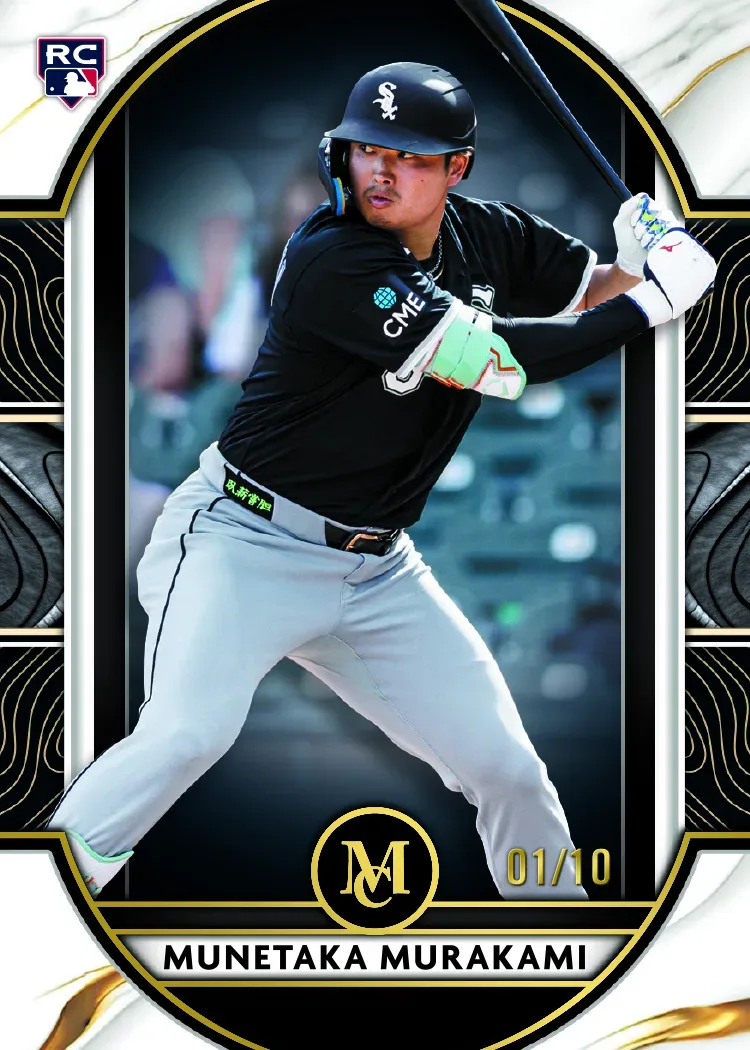 Card image: Topps (Topps Ripped Museum Collection guide)
One-of-ones. Topps Ripped calls a 1/1 "the rarest type of trading card." Three kinds show up again and again on 2026 Topps checklists:
- Superfractors. "Short-printed, 1-of-1 cards," per Topps Ripped, so "there will be only one superfractor of that card in the entire product." Topps Ripped's Bowman Football early-pulls post (October 6) led with an "Arch Manning SuperFractor 1/1."
- Printing plates. The metal plates used to print the card. They "typically come in four different colors: cyan, magenta, yellow, and black" and "are often offered as one-of-one collectibles for each color."
- Cut signatures and named one-of-ones. Allen & Ginter's 51 Cut Signatures, the Update Series "one-of-one Foilfractor" in hobby, and the Foil Filagree ladder that ends at "one-of-one Purple Foil Filagree."
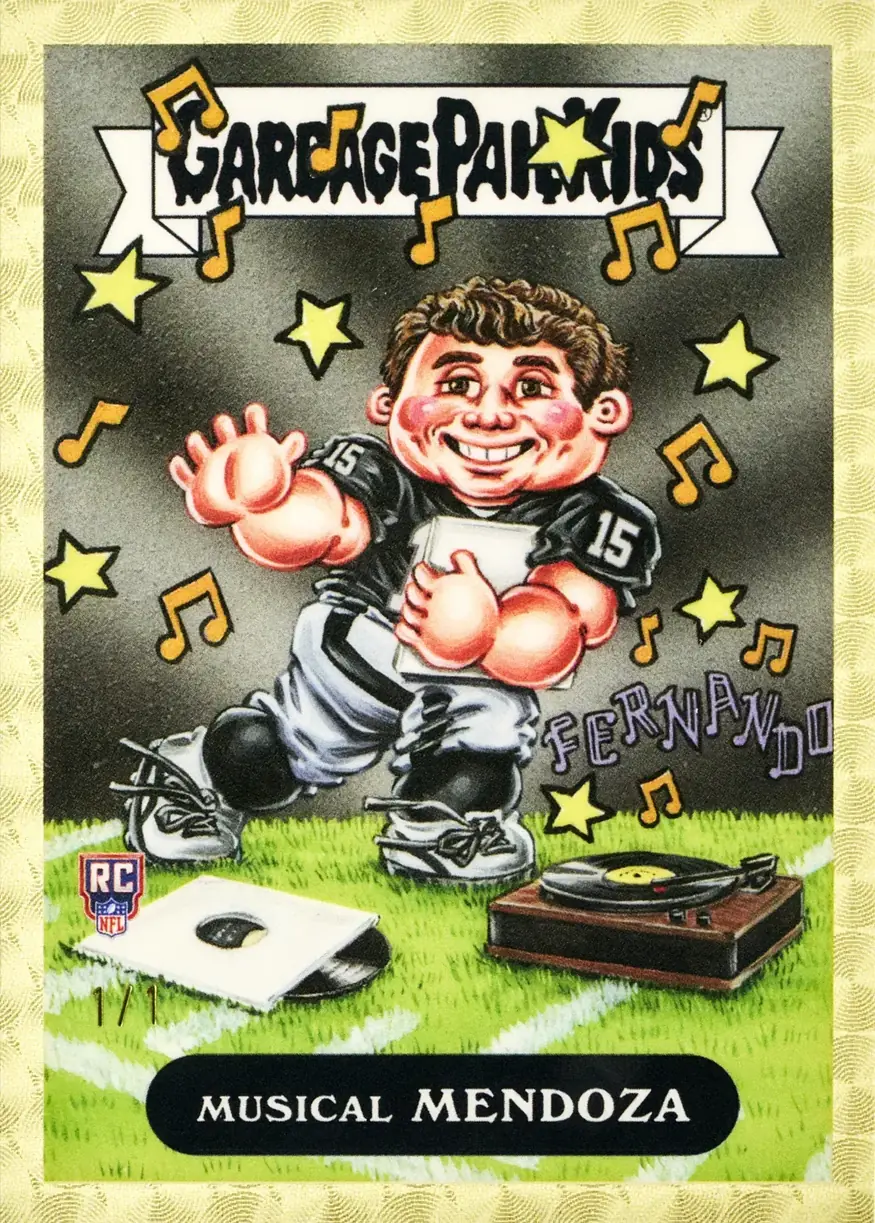 Card image: Topps (Topps Ripped Bowman Football early pulls)
GODEEPER: How to read an odds sheet column by column, with the hobby, jumbo and retail formats explained. Sports Card Boxes Explained: Hobby vs Jumbo vs Blaster →
Analysis: where Topps tells you the print run (and where it does not)
The odds sheet will not tell you the print run. We read four 2026 Topps odds sheets and three checklists, and none prints a /N next to a parallel. The Update Series checklist has no "/" followed by a number anywhere in its text. What the sheet gives instead is a ratio for each box format.
Take the same one-of-one parallel through both documents. Topps' Update Series box guide promises hobby parallels "down to a one-of-one Foilfractor." The Update Series odds sheet lists "BASE CARDS FOILFRACTOR" at 1:10,923 in the hobby column. One document gives the run, the other the ratio.
That split holds across products:
| Card | Run (Topps guide or card) | Ratio (Topps odds sheet) |
|---|---|---|
| Update Series Foilfractor | one-of-one | 1:10,923 hobby |
| Topps Chrome Superfractor | one-of-one (Ripped definition) | 1:16,958 hobby, 1:24,256 jumbo, 1:155,634 value |
| Cosmic Chrome Superfractor | one-of-one (Ripped definition) | 1:7,567 hobby |
| Allen & Ginter Rip Cards | Single /199, Dual /50 | 1:81 and 1:1,212, hobby only |
The ratio depends on the format. On the Topps Chrome sheet the Gold Refractor reads 1:341 in hobby and 1:3,008 in value boxes, roughly nine times longer odds in value by our math. The print run is the same in every format; only your chance per box changes. Topps also prints a caveat on every sheet: "actual contents and odds may vary." For Chrome's full refractor ladder by format, see our Cosmic Chrome odds guide.
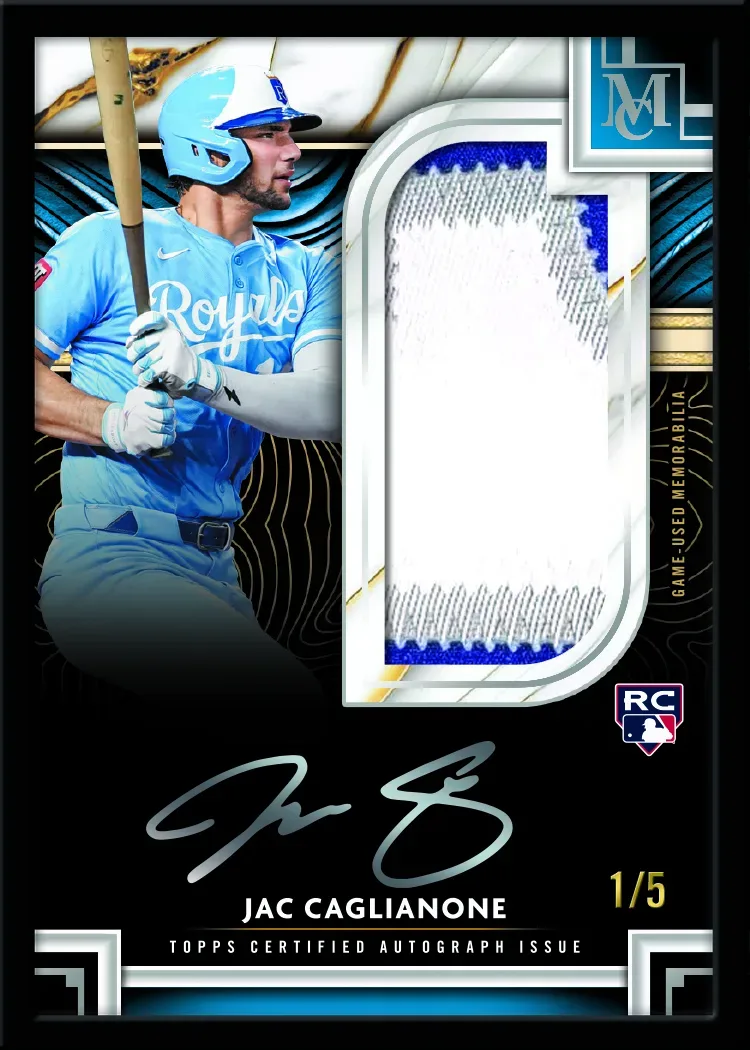 Card image: Topps (Topps Ripped Museum Collection guide)
Rip Cards are numbered too. Topps' Allen & Ginter box guide says "Single Rip Cards numbered to 199 and Dual Rip Cards numbered to 50" are "found only in this format," meaning hobby. Watch the checklist here: it lists cards such as "RIP-199" and "RIP-50," and those are card numbers, not print runs.
GODEEPER: Allen & Ginter's Rip Cards, Uniform Countdown and one-of-one Cut Signatures, with Topps' odds by format. 2026 Topps Allen & Ginter Checklist, Odds and Box Guide →
Jersey numbers, serial numbers and PSA numbers
A jersey number card is a numbered card "whose card's sequential number matches the player's uniform number," per Topps Ripped, which uses the example of Tom Brady cards "numbered #12/50, #12/25, or #12/150." 2026 Allen & Ginter builds a parallel around the idea: its box guide lists "Uniform Countdown parallels, numbered to each player's uniform number" as case-level content.
A card's serial number is also not its grading number. PSA's certification number is printed on the slab label; PSA announced in 2015 that "the item's unique PSA serial number and barcode now will appear on both the back as well as the front of the label." That number identifies the slab. The card's 05/25 identifies the copy. If you plan to grade a low-numbered card, our PSA grading fees breakdown has the current tiers.
Community: what collectors are saying
Two r/sportscards threads from this summer show how collectors weigh the numbers. In "25/99 and #25?", posted July 29, 2026, u/joshmalonern wrote: "Maybe a couple bucks. It takes the right buyer to actually care about jersey match numbering. All it really does is make it stand out compared to the other 98 cards in the same parallel." (comment). In a thread posted August 1, u/PatienceDifficult344 gave a simple ranking: "More fabric colors the better. Lower # the better ie /199 /150 /99 /50 /25 /5" (comment). Both are opinions, not price data.
Our take
Based on Topps' definitions, guides and odds sheets: the stamped number tells you how many copies exist, and nothing else on Topps' paperwork does. The checklist names the card, the odds sheet tells you how often a box format produces it, and the run lives on the card and in Topps Ripped's write-ups. When you compare two numbered parallels, compare the run first, then the ratio for the box you are buying. A jersey-matching serial or a 1/1 is a feature some collectors pay for, but the print run does not set a price.
Frequently Asked Questions
The six questions collectors ask most, what /99 means, 1/1s, odds sheets, jersey numbers, PSA numbers and whether lower is rarer, are answered in the FAQ block on this page.
What does /99 mean on a sports card?
It means the card is part of a print run of 99. Topps Ripped defines numbered cards as short-printed cards whose print run is specified on the front or back, so a card stamped 10/100 is the tenth card of a run of 100. The first number is the copy, the second is the total.
Is a 1/1 card the rarest kind of card?
Yes. Topps Ripped calls a 1/1 the rarest type of trading card: only one copy of that exact card exists. Superfractors, printing plates in each color and cut signature cards are all common one-of-one formats on 2026 Topps checklists, and several are named in Topps' box guides.
Do Topps odds sheets show print runs?
No. The 2026 Topps odds sheets we read give only ratios such as 1:10,923 for each box format, and the checklists list card numbers without any /N. Print runs show up on the card itself and in Topps Ripped's box and collector guides, which say things like numbered to 50.
What is a jersey number card?
Topps Ripped defines it as a numbered card whose serial number matches the player's uniform number, so a quarterback who wears 12 might have a card numbered 12/50. On 2026 Allen & Ginter, Topps' box guide lists Uniform Countdown parallels numbered to each player's uniform number.
Is the serial number on a card the same as the PSA number?
No. A card's serial number, like 05/25, is printed by the manufacturer and shows the print run. PSA's certification number is a separate number on the slab label; PSA said in 2015 that it appears on the front and back of the label with a barcode.
Does a lower number mean a rarer card?
For the same card, yes: a /5 version has five copies and a /50 version has fifty. Across different cards the number alone does not settle it, because each parallel has its own run and each box format its own odds. One r/sportscards commenter listed /199 down to /5 as the order to prefer.
How we checked this
Definitions from Topps Ripped's glossary pages, read in a headless browser on October 10, 2026. Print runs from Topps Ripped box and collector guides dated July 20 to October 6, 2026, and from Topps' own card images on those pages, checked by eye. Ratios from the 2026 Topps Chrome, Cosmic Chrome, Update Series and Allen & Ginter odds sheets, extracted with a PDF text reader; we searched the checklist text for any "/N" and found none. Full source table: data/sources/numbered-cards-explained.sources.md.
References
- Topps Ripped, numbered card definition: https://ripped.topps.com/definition/numbered/
- Topps Ripped, parallel, refractor, Superfractor, printing plate, one-of-one and jersey number definitions: https://ripped.topps.com/glossary/
- Topps Ripped, 2026 Topps Chrome box guide: https://ripped.topps.com/2026-topps-chrome-baseball-box-comparison/
- Topps Ripped, 2026 Allen & Ginter box guide: https://ripped.topps.com/2026-allen-ginter-baseball-hobby-vs-value-box-guide/
- Topps Ripped, 2026 Museum Collection guide: https://ripped.topps.com/2026-topps-museum-collection-baseball-guide/
- Topps Ripped, 2026 Inception Football guide: https://ripped.topps.com/2026-topps-inception-football-collector-cards-guide/
- Topps odds sheet, 2026 Topps Chrome Baseball (PDF): https://cdn.shopify.com/s/files/1/0662/9749/5709/files/2026_Topps_Chrome_Baseball_Odds.pdf?v=1784729528
- Topps odds sheet, 2026 Update Series (PDF): https://cdn.shopify.com/s/files/1/0662/9749/5709/files/2026_Topps_Baseball_Updates_Series_Odds.pdf?v=1790610141
- PSA, label security update (2015): https://www.psacard.com/articles/articleview/8742/psa-enhances-label-security-second-barcode-serial-number
Related Reading
- Sports Card Release Calendar 2026: Oct and Nov Dates: every upcoming Topps release, so you know when new numbered parallels arrive.
- 2026 Topps Update Rookies: All 111 Players on the Checklist: where each rookie sits on the Update Series checklist, parallels included.
About the author

Editorial desk
The RookieDesk desk. Every article is built from a source file: manufacturer checklists and odds sheets, grading company fee pages, and dated sale data, each linked in the article.
Keep reading
2026 Topps Cosmic Chrome Baseball Odds and Parallels Guide
Guides · 7 min
2026 Topps Allen & Ginter Checklist, Odds and Box Guide
Guides · 10 min
Sports Card Boxes Explained: Hobby vs Jumbo vs Blaster
Guides · 15 min
2026 Topps Heritage Football Checklist and Box Guide
Guides · 10 min
2026 Topps Update Rookies: All 111 Players on the Checklist
Guides · 11 min
Rookie Cards Explained: RC Logo, 1st Bowman and 2026 Classes
Guides · 13 min
2026 Topps Update Series Checklist, Odds and Box Guide
Guides · 9 min
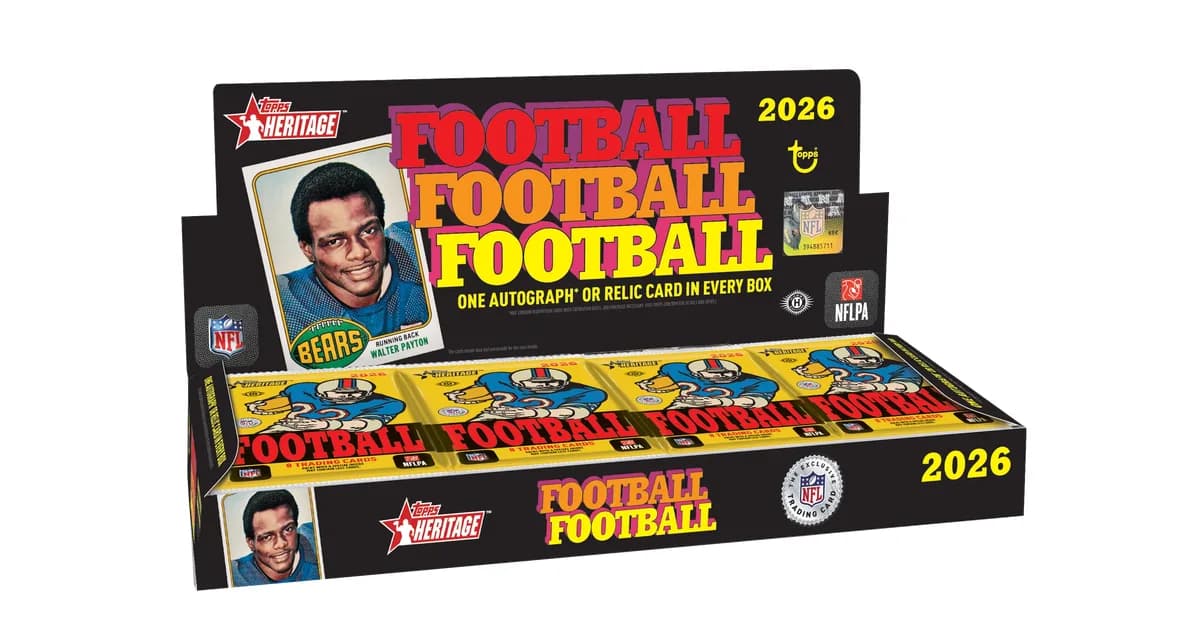
Sports Card Release Calendar 2026: Oct and Nov Dates
Guides · 14 min
Disclaimer
RookieDesk publishes data, not investment or financial advice. Odds are the manufacturer's published odds, not a promise of what any one box contains. Checklists, release dates, grading fees and prices change after publication; each one here carries the date we checked it. Confirm critical details with the manufacturer, grader or seller before you buy or submit. RookieDesk is not affiliated with any card manufacturer, league or players association; see our independence note.