Guides
What Is a Pop Report? PSA, SGC and CGC Population Explained
What is a pop report? How PSA, SGC and CGC count graded cards, how to read one with a real PSA example, and what the counts cannot tell you about a card.

What is a pop report? It is a grading company's running count of how many copies of each card it has graded, grade by grade. This guide explains how the PSA, SGC and CGC population reports work, reads a real PSA table for a Mike Trout rookie as of October 11, 2026, and lists what those counts cannot tell you.
TL;DR: A pop report counts the cards one grader has graded, by grade. PSA calls its version "a tally of every single card we have ever graded and encapsulated." It does not count raw cards, cards graded elsewhere or cards the grader rejected, and resubmitted cards can be counted twice. CGC states its counts "are not an indicator of value or rarity." Use them as a dated count, not a verdict.
What is a pop report? (quick answer)
A pop report (population report) is a database published by a grading company that shows how many copies of a specific card it has graded at each grade. PSA's own definition: "the PSA Population Report is a tally of every single card we have ever graded and encapsulated," and "The Report breaks down the card by set, player and grade."
Key Takeaways
- One grader at a time: each report covers only that company's slabs.
- Graded, not printed: PSA says the numbers "do not represent ALL CARDS IN EXISTENCE."
- Low pop is not proof of rarity: cheap cards often go unsubmitted, PSA notes.
- Duplicates happen: cracked-out and resubmitted cards can be counted twice.
- Access in October 2026: CGC open, SGC behind a reCAPTCHA on search, PSA pop pages behind a sign-in, Beckett's page redirected to a maintenance notice.
- Dated: grader counts change over time, so every number here carries its check date.
Overview: what is a pop report at PSA, SGC, CGC and Beckett
PSA, SGC, CGC and Beckett each publish a population report, and they differ in how you reach the data.
| Grader | What the report covers | How you search | What we could read, Oct 10 to 11, 2026 |
|---|---|---|---|
| PSA | Every card PSA has graded, by set, player and grade | Sign-in page (Oct 10) | Pop pages redirected to a sign-in (Oct 10); CardFacts card pages loaded |
| SGC | SGC-graded cards, with "over 28 years of data" | Enter a card set, then find the card | Page loaded; the set search asked for a reCAPTCHA |
| CGC Cards | TCGs, sports and non-sports cards CGC has graded | Sport, date range, set, or search | Loaded without signing in (Oct 11) |
| Beckett | Beckett-graded cards | n/a | The pop report URL redirected to a maintenance notice |
PSA. PSA describes its pop page in search listings as giving "an exact count of each item graded, from PSA 1-10." On this machine, PSA's pop URLs redirected to a Collectors sign-in page, so we read PSA's numbers from its CardFacts page for the card, which carries a population table.
SGC. SGC's page starts with: "Enter the card set you are looking for in the box below. Load your set, then find your card." It also warns: "With over 28 years of data included in the SGC Pop Report, inconsistencies may be present. If you find any inconsistencies/duplicates on the Pop Report, please email [email protected]." When we searched a set, the page asked us to complete a reCAPTCHA, so we read no SGC counts.
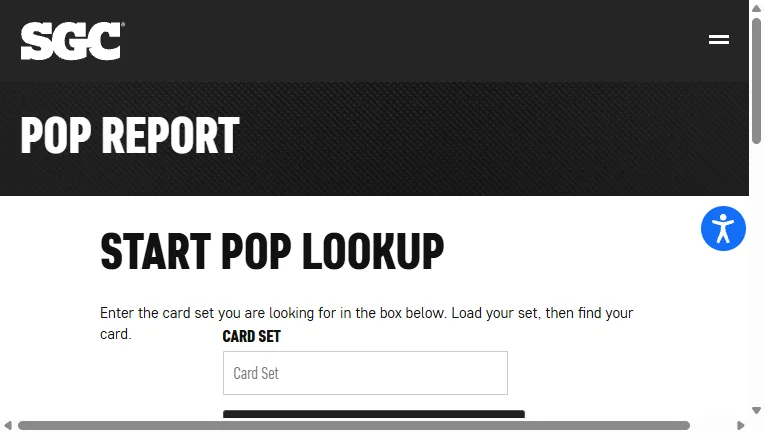 Screenshot: SGC pop report page (gosgc.com), October 11, 2026
CGC Cards. CGC says its report "shows the latest number of TCGs, sports cards and non-sports cards that CGC Cards has graded," and "the CGC Cards Population Report for sports cards is organized by sport, date range and set." If a CGC card is missing, CGC's help page says to "try going to CGCcards.com/Verify and enter your certification number."
Beckett. Beckett's pop report address redirected to its maintenance page on October 11, 2026. That page says Beckett has "temporarily paused Base and Standard card grading submissions," with Express open through a temporary form. Our sports card grading guide covers where each grader stands on fees and turnaround.
Analysis: how to read a pop report, with a real PSA example
Take the 2011 Topps Update #US175 Mike Trout rookie card. PSA's CardFacts page for it, read on October 11, 2026, lists the population at every grade:
| PSA grade | Population | POP Higher |
|---|---|---|
| GEM - MT 10 | 7,065 | n/a |
| MINT 9 | 5,691 | 7,065 |
| NM - MT 8 | 1,689 | 12,915 |
| NM 7 | 697 | 14,618 |
| EX - MT 6 | 745 | 15,327 |
| EX 5 | 287 | 16,077 |
| VG - EX 4 | 130 | 16,366 |
| VG 3 | 28 | 16,498 |
| GOOD 2 | 9 | 16,526 |
| FR 1.5 | 1 | 16,535 |
| PR 1 | 7 | 16,536 |
| Auth | 17 | 16,543 |
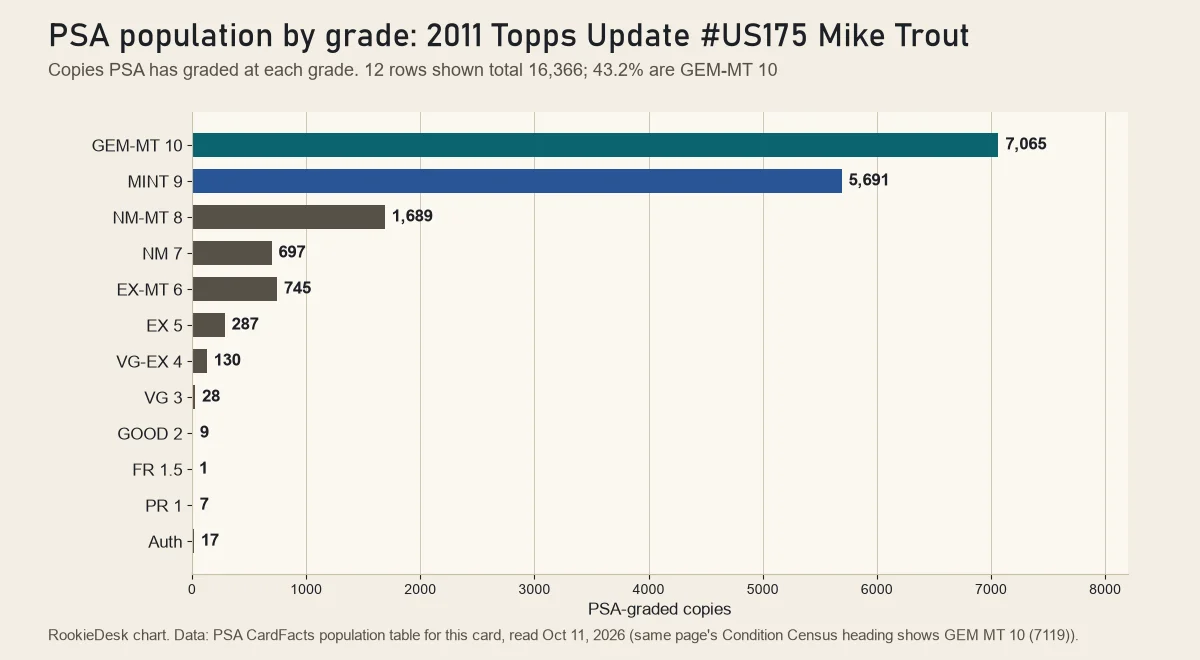 Chart: RookieDesk, from PSA CardFacts population table (October 11, 2026)
Read the whole row, not just the top. The 12 rows printed on the page add up to 16,366 copies, including 17 listed as "Auth," which is not a numeric grade; that is our sum of the rows shown, not a PSA total. On our arithmetic, 43.2% of them are GEM-MT 10 and 34.8% are MINT 9. A grade's population tells you how many copies share it; the share tells you how often that grade comes back for this card at PSA.
POP Higher is the column PSA prints next to each grade. The CardFacts page does not define it, and the printed figures are not a simple running sum of the rows above: NM-MT 8 shows 12,915, while GEM-MT 10 plus MINT 9 is 12,756. We quote the column as printed and do not compute from it.
Two numbers on one page. The same CardFacts page shows "GEM MT 10 (7119)" in its Condition Census heading and 7,065 in the population table. PSA says the Condition Census "is a work-in-progress and should only be used as a guide." Two figures from one grader on one day is a good reason to always write down where and when you read a count.
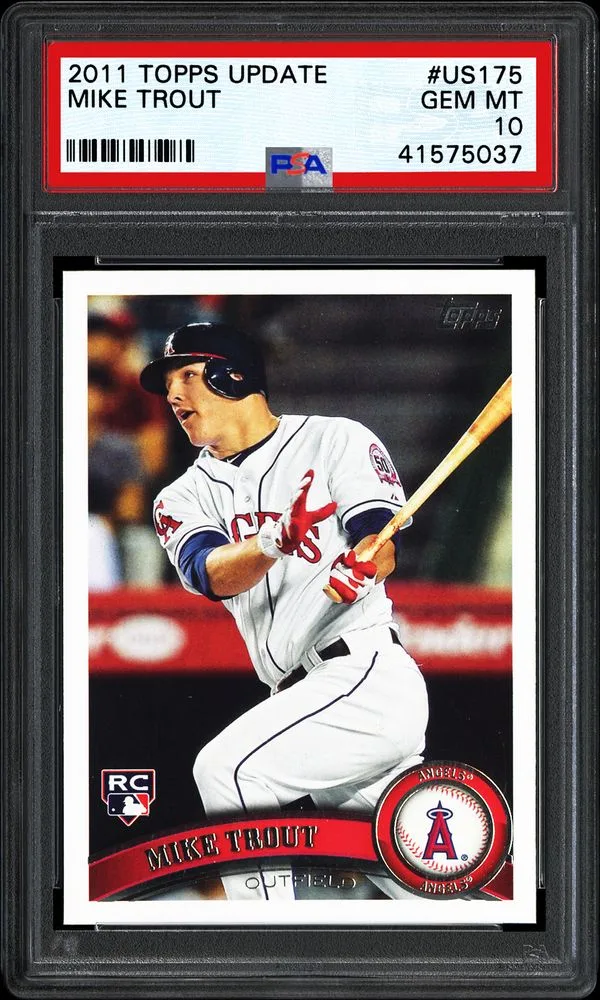 Card image: PSA CardFacts (psacard.com)
GODEEPER: The Trout card in the photo carries an RC logo; here is how RC logos and 1st Bowman cards mark a rookie. Rookie Cards Explained: RC Logo, 1st Bowman and 2026 Classes →
Analysis: what a pop report cannot tell you
It is not a print run. PSA is direct: "The population numbers do not represent ALL CARDS IN EXISTENCE, they merely represent the ones that have been graded by PSA." A serial-numbered card is different: Topps' glossary says its "print run is specified on either the front or back of the card." Our numbered cards guide explains that.
Rejected cards are missing. PSA adds: "The numbers also do not include all the cards that have been rejected for evidence of alteration, restoration or questionable authenticity." PSA's grading standards say it "will not grade cards that bear evidence of trimming, re-coloring, restoration, or any other forms of tampering."
Low pop can mean low interest. In the same article PSA describes a card with a population of four at Mint 9 because "very few people had even bothered to submit the card over the past 11 years due to its extremely low value." It also warns that "many lower quality cards never make it to PSA for grading at all so the numbers will sometimes seem skewed."
Resubmissions inflate counts. Packz, a secondary source, describes "duplicates created when a card is cracked out of its slab and resubmitted for a higher grade." SGC's own notice asks collectors to report duplicates.
Graders say it themselves. CGC's disclaimer reads: "Census / Population Reports only reflect the quantities and types of collectibles previously graded by the CCG Companies, and are not an indicator of value or rarity." It adds that the data "should not be relied upon for the purpose of making a purchase or an investment."
Scale differs by category. CGC's page listed 3,840,806 sports cards graded on October 11, 2026, against 13,714,911 trading card game cards and 1,753,907 non-sports cards. Our reading, not CGC's: a small CGC sports count may reflect where collectors send sports cards as much as how scarce a card is.
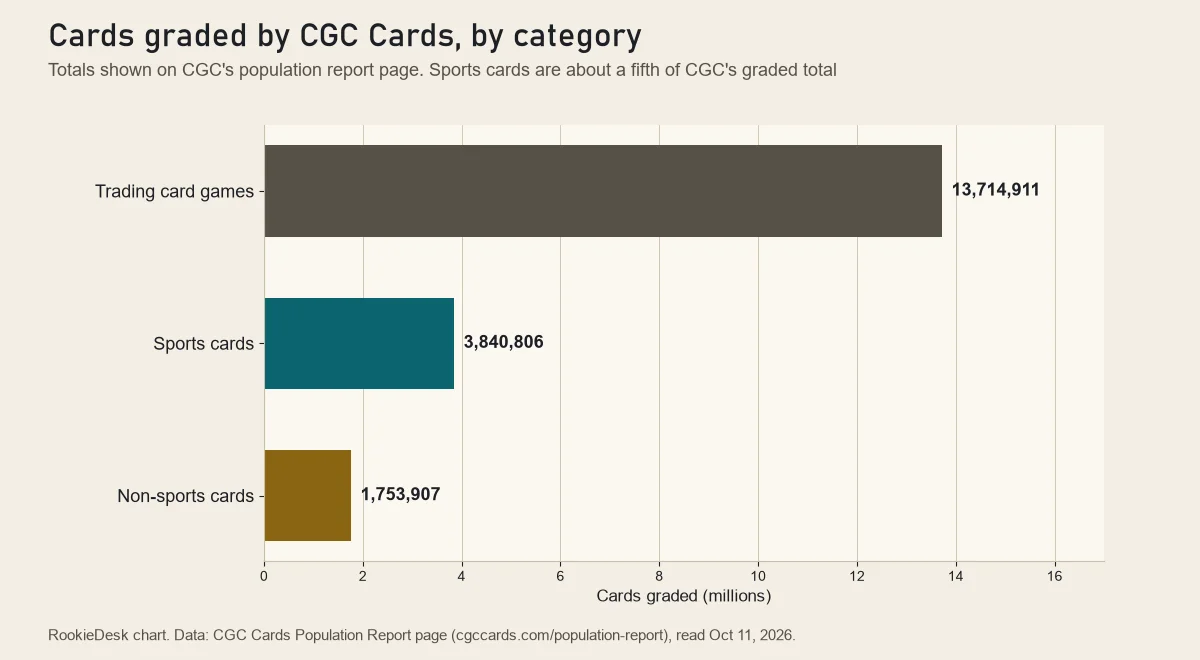 Chart: RookieDesk, from the CGC Cards Population Report page (October 11, 2026)
Analysis: grade names and qualifiers on a PSA report
PSA's labels in the report are its grade names: "GEM - MT 10," "MINT 9," "NM - MT 8" and down to "PR 1." PSA's grading standards define the top one: "A PSA Gem Mint 10 card is a virtually perfect card." Qualifiers flag a specific problem; for example, cards with "writing, ink marks, pencil marks, etc." are "designated "MK."" PSA also notes that "the graders reserve the right, based on the strength or weakness of the eye appeal, to make a judgment call on the grade of a particular card." What each grade costs to chase is a separate question; our PSA grading fees guide lists every tier, and the grading fee calculator compares PSA, SGC and CGC on the same card.
How to look up a card on a pop report
1. Pin down the exact card. Year, set and card number, for example 2011 Topps Update #US175.
2. Pick the grader that matches the slab. A PSA pop does not include SGC or CGC copies. To compare, read each grader separately and add the date to each figure.
3. Read the full grade row. Note the count at your grade, the count above it, and the total. A 10 that is 43% of the graded copies is a different picture from a 10 that is 1%.
4. Check what is missing. Raw cards, rejected cards and resubmissions are outside or distort the count. For a CGC card you cannot find, CGC suggests entering the certificate number on its verify page.
Community: what collectors run into
Two r/psagrading posts describe trouble using the reports. On r/psagrading, u/shortking89 wrote that "it is so hard to find a card on PSA's population report" (thread). Another poster, u/Why_cant_I_partake, waiting on a submission, wrote: "For the past 2 weeks I noticed the pop count didnt change" (thread).
Our take
Based on the graders' own pages and the labelled secondary sources cited above: a pop report is a useful count with a narrow meaning. It tells you how many copies one company has slabbed at each grade on the day you look, and the Trout table shows how much the grade spread can say about a card. It does not tell you how many copies exist, how many were rejected, or how many entries are the same card resubmitted. Read each grader separately, write down the date, and treat "low pop" as a question to check, not a conclusion.
Frequently Asked Questions
The six questions above cover what a pop report is, whether low pop means rare, where to find PSA's report, resubmissions, CGC access and buying decisions.
What is a pop report in sports cards?
A pop report, short for population report, is a grader's count of how many copies of a card it has graded at each grade. PSA calls its report a tally of every card it has ever graded and encapsulated, broken down by set, player and grade. SGC and CGC publish their own counts.
Does a low pop mean a card is rare?
Not on its own. PSA says its numbers only cover cards it graded, not all cards in existence, and that a low count can simply mean few people bothered to submit a cheap card. CGC states that its population reports are not an indicator of value or rarity.
Where can I find the PSA pop report?
PSA's population pages are on psacard.com, but when we checked on October 10, 2026 they redirected to a sign-in page. PSA's CardFacts page for a card also shows a population table by grade, and that page loaded without signing in.
Do pop reports include cards that were cracked out and resubmitted?
They can. Packz, a secondary source, says a card cracked out of its slab and resubmitted for a higher grade can create a duplicate entry, and SGC asks collectors to email any inconsistencies or duplicates they find in its report.
Can I see the CGC population report without an account?
Yes. CGC's population report page loaded without signing in on October 11, 2026. It is organized by sport, date range and set for sports cards, and the page listed 3,840,806 sports cards graded. If your CGC card is missing, CGC suggests checking its certification number on its verify page.
Should I buy a card because it has a low pop?
RookieDesk does not give buying advice. CGC's own disclaimer says its population data should not be relied on for a purchase or an investment. A pop report shows how many graded copies one grader has counted for a card, nothing more.
How we checked this
PSA's definitions come from its "Population Perspective" article and grading standards page, read on October 10, 2026. The Trout table was read from PSA's CardFacts page with curl and a Chrome user agent on October 10 and re-read on October 11, 2026. SGC's and CGC's population pages were read in a headless browser on October 11, 2026; Beckett's pop report address was checked the same day. Packz is a secondary source, labelled where used. Reddit posts were read through a subreddit search RSS feed on October 10. On October 14 we re-read the PSA, CGC, SGC, Beckett, Packz and Reddit pages: the quoted wording had not changed, while the counts had grown slightly (Trout GEM-MT 10 population: 7,065 on October 11, 7,067 on October 14), so every count here stays dated October 11. The hero image combines two PSA images, from the CardFacts page and PSA's grading standards page. The grade shares are RookieDesk's arithmetic. We have not submitted cards for this article. Full source table: data/sources/what-is-a-pop-report.sources.md.
References
- PSA, "Market Report: Population Perspective": https://www.psacard.com/articles/articleview/3631/market-report-population-perspective
- PSA, grading standards: https://www.psacard.com/gradingstandards
- PSA CardFacts, 2011 Topps Update #US175 Mike Trout: https://www.psacard.com/cardfacts/baseball-cards/2011-topps-update/mike-trout-us175/650905
- SGC, pop report: https://www.gosgc.com/pop-report
- CGC Cards, population report: https://www.cgccards.com/population-report/
- CGC Cards, help center on the pop report: https://www.cgccards.com/about/help-center-faqs/cgc-cards-website/cgc-cards-pop-report/
- Beckett, grading status page: https://maintenance.beckett.com/
- Packz, SGC population report guide (secondary): https://packz.io/blog/sgc-population-report-guide
- Reddit r/psagrading, "When are cards added to the pop report": https://www.reddit.com/r/psagrading/comments/1t15qbm/when_are_cards_added_to_the_pop_report/
Related Reading
- SGC Grading Fees 2026: Every Tier After the September Change: what SGC charges per card before a slab reaches its pop report.
- CGC Grading Fees 2026: Every Tier and Price for Sports Cards: CGC's tiers, and its two different 10s.
- How to Start Collecting Sports Cards: 2026 Beginner Guide: the card types and terms to know before grading anything.
About the author

Editorial desk
The RookieDesk desk. We read the paperwork before you open the box: Topps' checklists and odds sheets, the box art, grader fee pages. Every number links to its source and carries the date we checked it.
Keep reading
CGC Grading Fees 2026: Every Tier and Price for Sports Cards
Guides · 9 min

SGC Grading Fees 2026: Every Tier After the September Change
Guides · 8 min
Sports Card Grading 2026: PSA vs SGC vs CGC vs Beckett
Guides · 14 min
PSA Grading Fees 2026: Every Tier, Price and Turnaround
Guides · 8 min

2026 Bowman U Best Football: Checklist, Box and Case Hits
Guides · 8 min

How to Read Sports Card Odds: Topps Odds Sheets Explained
Guides · 11 min
2026 Topps Holiday Baseball: Checklist, Boxes and Release
Guides · 9 min

Late October 2026 Sports Card Releases: Dates and Boxes
Guides · 8 min
Disclaimer
RookieDesk publishes data, not investment or financial advice. Odds are the manufacturer's published odds, not a promise of what any one box contains. Checklists, release dates, grading fees and prices change after publication; each one here carries the date we checked it. Confirm critical details with the manufacturer, grader or seller before you buy or submit. RookieDesk is independent and not affiliated with any card manufacturer, league or players association, and carries no affiliate links, ads or sponsored posts; see our independence note. Articles are researched and written with AI tools, and every fact is checked against its cited source before publishing; see how we use AI.