Guides
How to Spot a Trimmed Sports Card: PSA and CGC Red Flags
How to spot a trimmed sports card: PSA's four N1 edge red flags, what Authentic Altered means on PSA and CGC labels, and why a ruler alone can mislead.
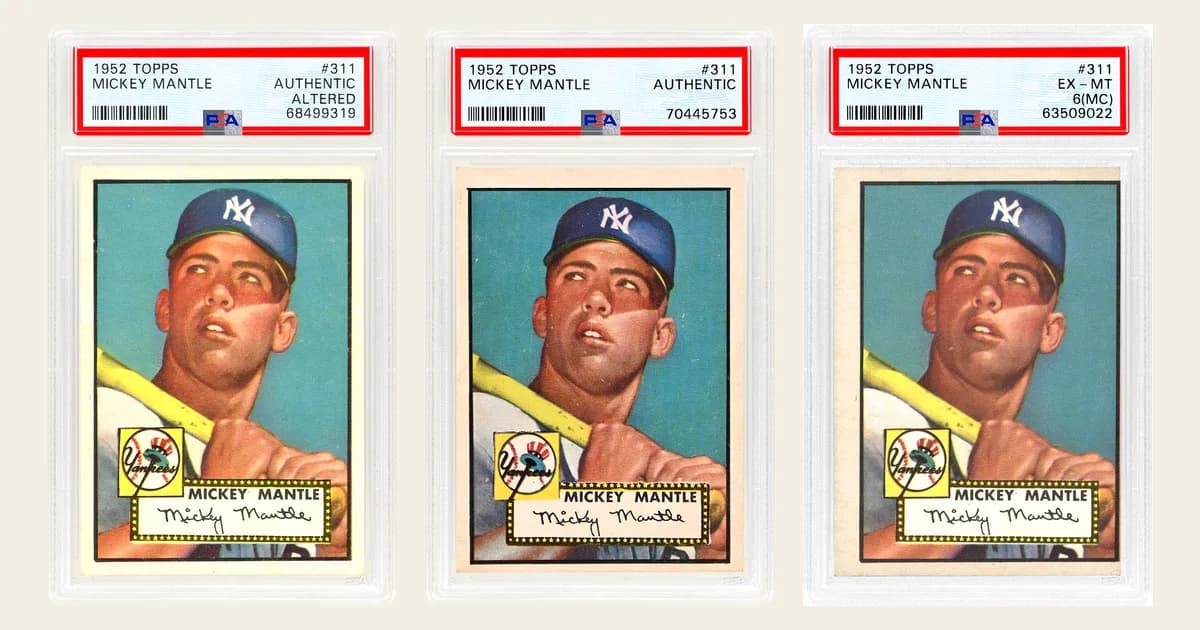
How to spot a trimmed sports card starts at the edges, because that is where a card doctor leaves marks. This guide uses PSA's grading standards, CGC's grading scale and both graders' guarantee terms, read on October 11, 2026, plus older advice from collectors who measured cards by hand.
TL;DR: PSA's N1 code lists four red flags: a hooked edge, edges that are unusually sharp for the issue, an edge whose color tone does not match, and a wavy, unnatural cut. PSA "will not grade cards that bear evidence of trimming"; at most they come back as Authentic Altered, at the grader's discretion and only if you asked for it. A ruler helps (standard cards are 2-1/2 by 3-1/2 inches) but does not settle it, because factory miscuts and undersized issues exist. An "Authentic" PSA label does not promise an unaltered card.
How to spot a trimmed sports card (quick answer)
Hold the card next to an untrimmed copy from the same set, then check each edge under magnification. PSA describes a card that appears trimmed as having "A hooked appearance along the edge, unusually sharp or uncommon edges for the issue, an inconsistent tone to the color of the edge in question or a wavy, unnatural look to the edges." If more than one of those shows up, treat the card as suspect until a grader looks at it.
Key Takeaways
- The red flags: hooked edge, too-sharp edges for the issue, mismatched edge tone, wavy cut (PSA, N1).
- The grader's answer: PSA "will not grade cards that bear evidence of trimming"; N1 cards can be slabbed as Authentic Altered only at the grader's discretion and if "AA" was requested.
- The fee: PSA charges the grading fee on an N1 card "in either case."
- Not every odd cut is a trim: PSA uses N8 for factory miscuts and N6 for cards undersized against factory specs.
- Read the label: CGC prints "Authentic Altered" on altered cards; PSA's guarantee treats "Authentic" as "potentially interchangeable" with Authentic Altered.
- Size: standard cards are 2-1/2 by 3-1/2 inches, but collectors warn that size comparison alone misleads.
Overview: what trimming is and why graders reject it
Trimming means cutting a card's edges after it left the factory, usually to make worn edges or corners look new. PSA's N1 entry is direct about the method: "A card doctor may use scissors, scalpel, cutter, or any other sharp instrument." PSA grades only cards it has authenticated first: "Grading can only take place after a trading card has been deemed authentic."
The best-known case shows what is at stake. In October 2013 the New York Daily News reported that Bill Mastro pleaded guilty to mail fraud and "admitted in the process that he had trimmed the Wagner card to sharply increase its value," the T206 Honus Wagner. The paper quoted the plea agreement: "defendant Mastro had altered the Wagner Card by cutting its side borders." The same article said altered cards "are worth considerably less" than unaltered ones.
Analysis: the four edge red flags in PSA's N1 definition
PSA's no-grade list is the most specific official description of a trim we found. Each of the four signs points to something you can check at home with a loupe and good light:
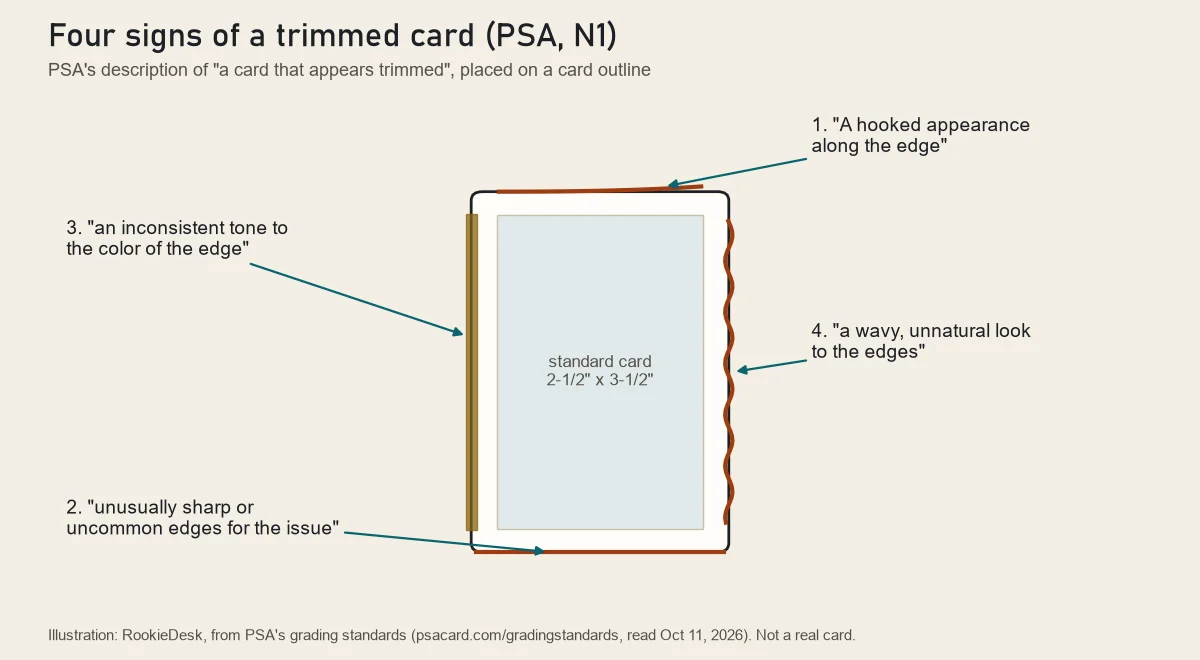 Illustration: RookieDesk, from PSA's N1 definition
- A hooked appearance along the edge. Sight down each edge and check that it runs straight from corner to corner.
- Unusually sharp or uncommon edges for the issue. The test is relative to the set, so compare with copies of the same issue, not with a card from another year or card stock.
- An inconsistent tone to the color of the edge. Compare the color of each edge with the other three under the same light.
- A wavy, unnatural look. Run a loupe along the full length of each edge, not just the corners.
Collectors add a few habits of their own. In a 2004 Collectors Universe thread, the member posting as norty wrote: "If you don't have a loupe, buy one of at least 10X magnification. Examine the grain of the card looking for consistency of cut." He also suggested checking the borders: "Are there low spots followed by up by high spots? It could be trimmed in the low areas."
GODEEPER: How PSA, SGC and CGC count the cards they have graded. What Is a Pop Report? PSA, SGC and CGC Population Explained →
Analysis: measuring helps, but size alone misleads
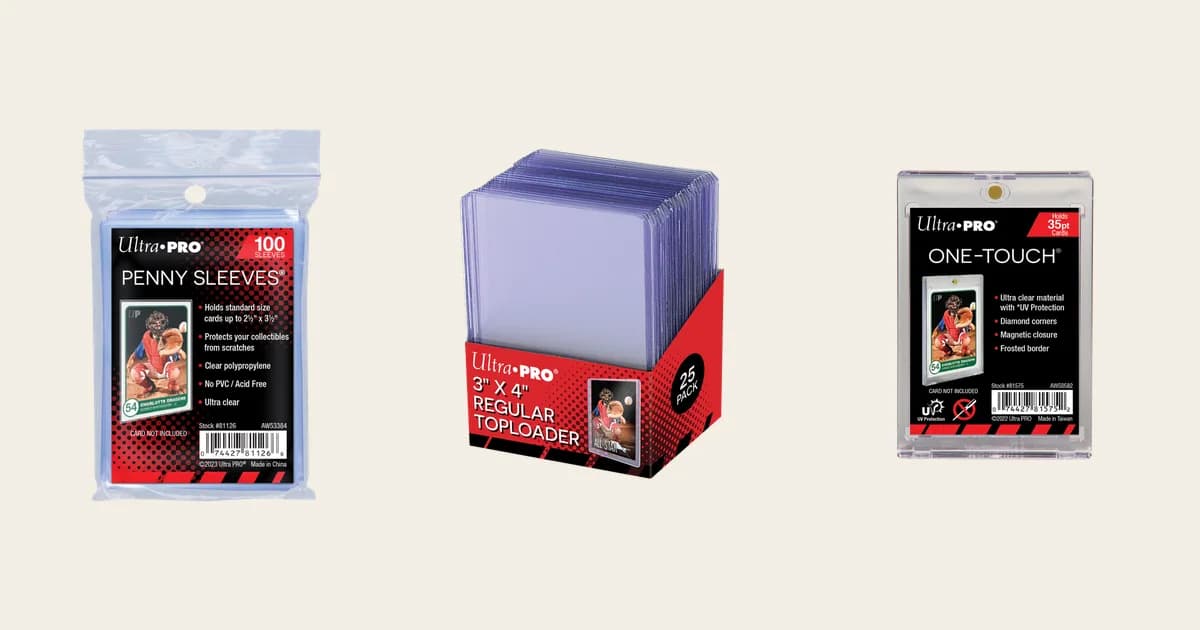
A standard card is 2-1/2 by 3-1/2 inches; Ultra PRO's toploaders are "designed to safely store standard size cards (2-1/2" x 3-1/2")." A card that is clearly short of that deserves a closer look. One collector, Virtualizard, measured 27 PSA-graded 1969 Topps cards in 2004 and reported: "For the most part, every card measured within 1/64" of the specified 2½" x 3½"." In the same thread he wrote that a card 3/16 of an inch short "is most definitely trimmed."
The same discussion explains why a ruler is not proof. norty wrote: "Comparative sizing is not a consistently good approach to detecting trims," and noted that "vending cards are consistently smaller and have consistently different cuts from the cards regularly issued." PSA makes the same distinction in its codes. N6 covers a card that is "significantly undersized according to factory specifications," and N8 covers a factory problem: "the factory cut is abnormal for the issue, causing the card's edges to deviate from their intended appearance."
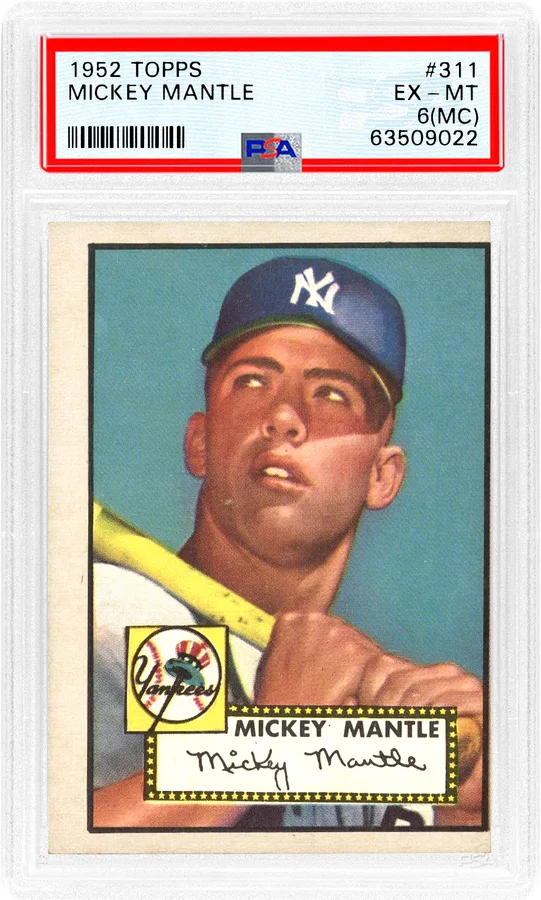 Image: PSA
The slab above, from PSA's grading standards page, carries a numeric grade with "(MC)" after it, and the card's left border is visibly wider than its right. MC is PSA's Miscut qualifier: PSA's June 2021 customer update says "the Marks (MK) and Miscut (MC) qualifiers will continue to be applied when warranted." A miscut card can still carry a number; a trimmed one cannot.
Hand-cut cards are their own case. PSA "will grade virtually any card that has been hand-cut off of a panel, box, etc.," such as Post Cereal, Hostess or Bazooka cards, but "will not grade cards cut from sheets that can be obtained in a normal fashion." To get a number, "evidence of that border must be present or the card must exhibit virtually-full borders"; if the cut goes past the border, PSA slabs the card as "Authentic" only.
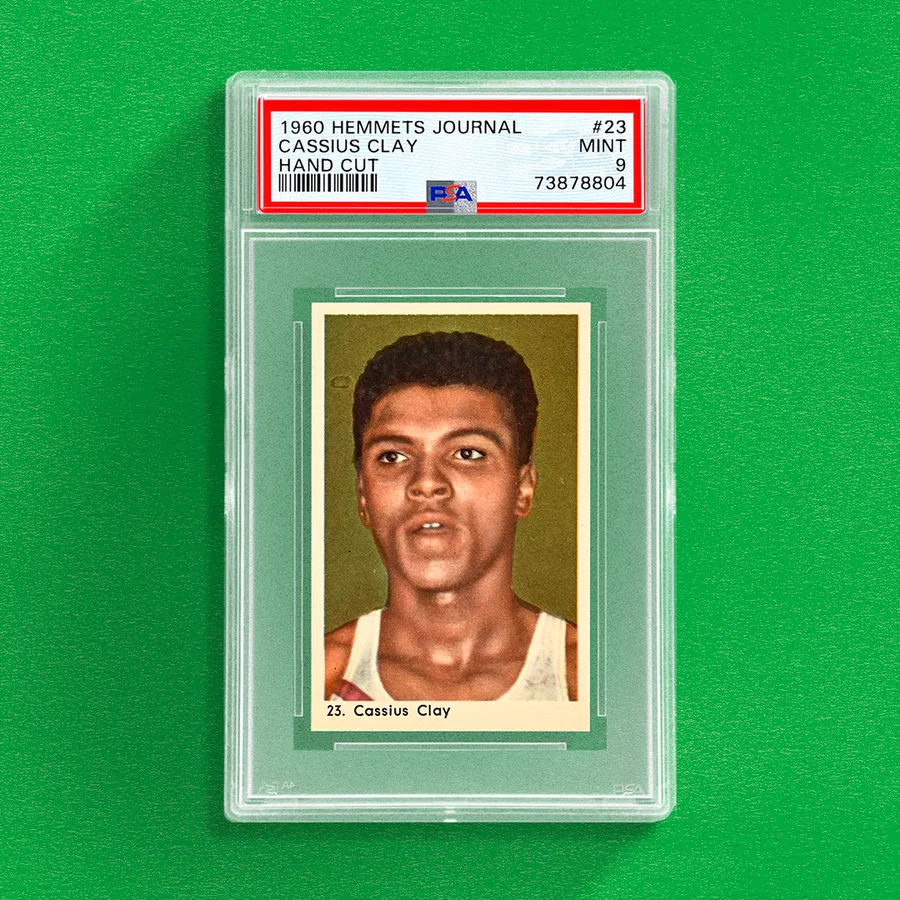 Image: PSA
Analysis: what PSA and CGC do with a trimmed card
PSA's rule is short: "PSA will not grade cards that bear evidence of trimming, re-coloring, restoration, or any other forms of tampering, or are of questionable authenticity." An N1 card comes back without a number, and "this designation can qualify for encapsulation as "Authentic Altered" at the grader's discretion and if "AA" is listed on the submission form as the desired minimum grade." Either way, "You will be charged the applicable grading fee in either case."
The fee rules differ by code, which matters if you are sending in a card you are unsure about:
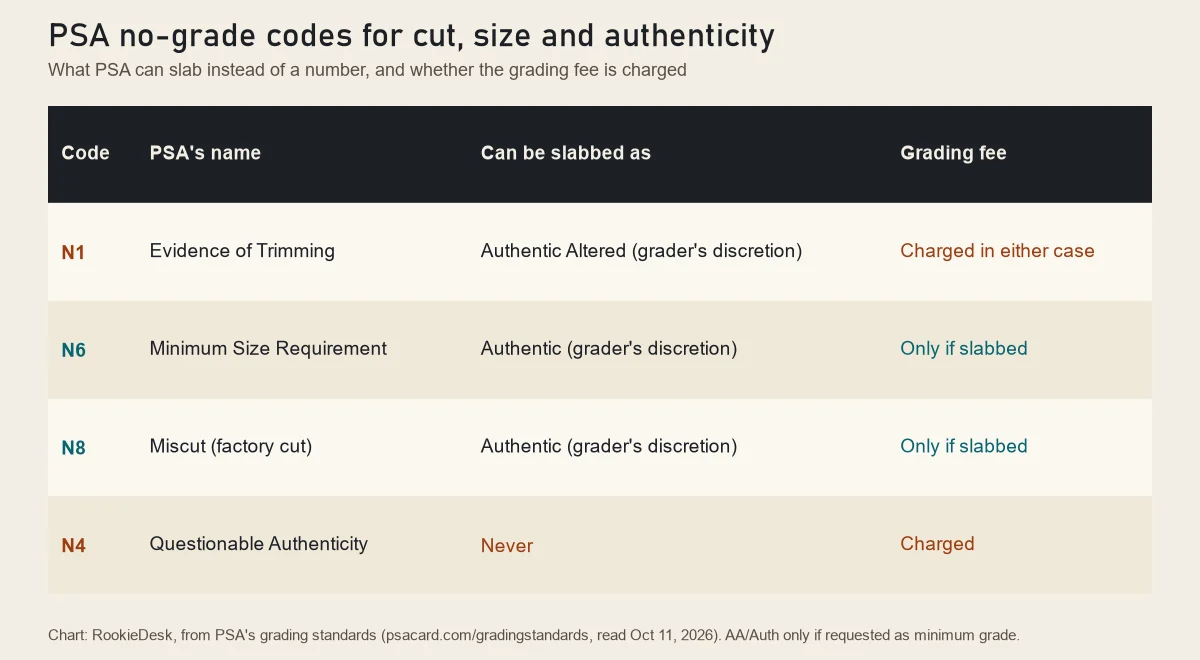 Chart: RookieDesk, from PSA's grading standards (read October 11, 2026)
CGC Cards uses the same label idea. Its grading scale says "CGC Cards will print Authentic Altered in the grade box if a card is authentic but has been altered. Examples of alterations include recoloring and trimming," and that its plain Authentic designation "is used for cards that are authentic and unaltered but cannot receive a numeric grade." CGC's FAQ says its tools assist graders with "card measurement and the detection of alterations and counterfeits," using "UV and infrared light, ultra-microscopic inspections and non-destructive ink and paper analysis."
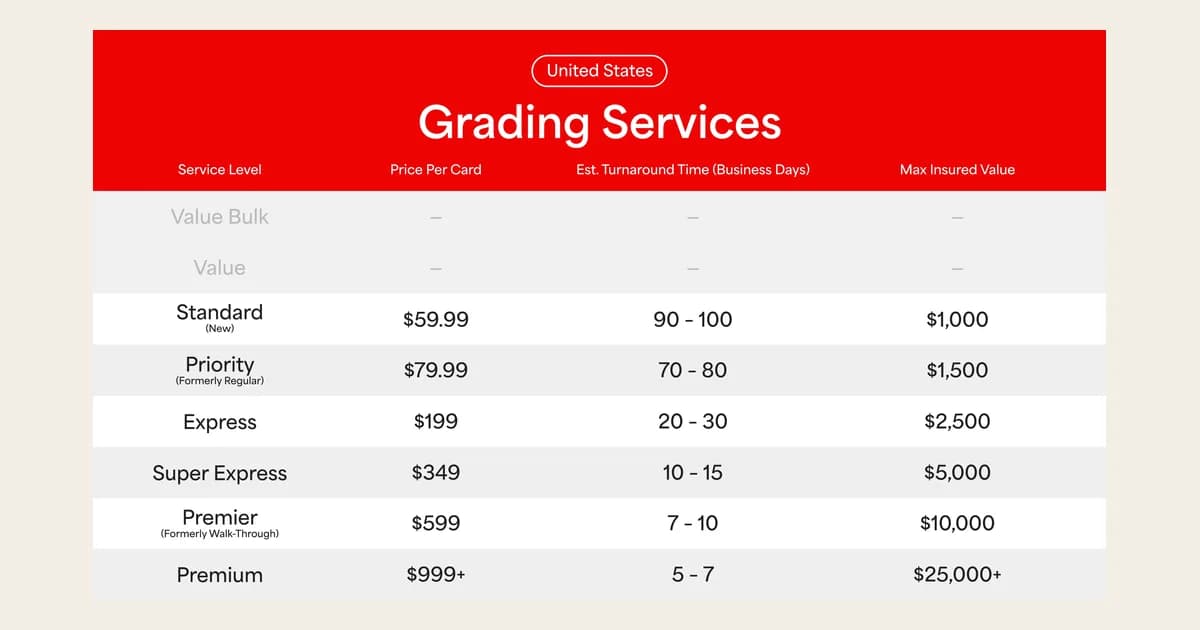
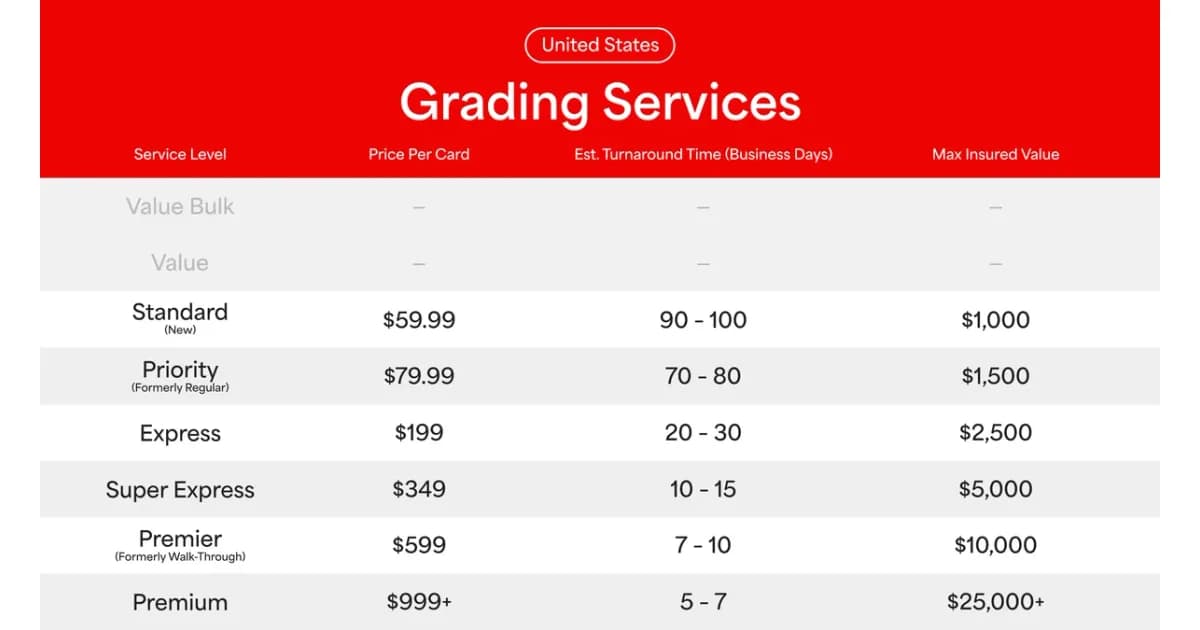
If you want to know why a card came back N1, PSA's price list matters: as of October 11, 2026, Grader Notes "that detail card defects and clarify the outcome" start at the Express tier, $199 per card. The PSA grading fees guide lists every tier, and the grading fee calculator totals an order across PSA, SGC and CGC.
Analysis: read the label before you buy a slabbed card
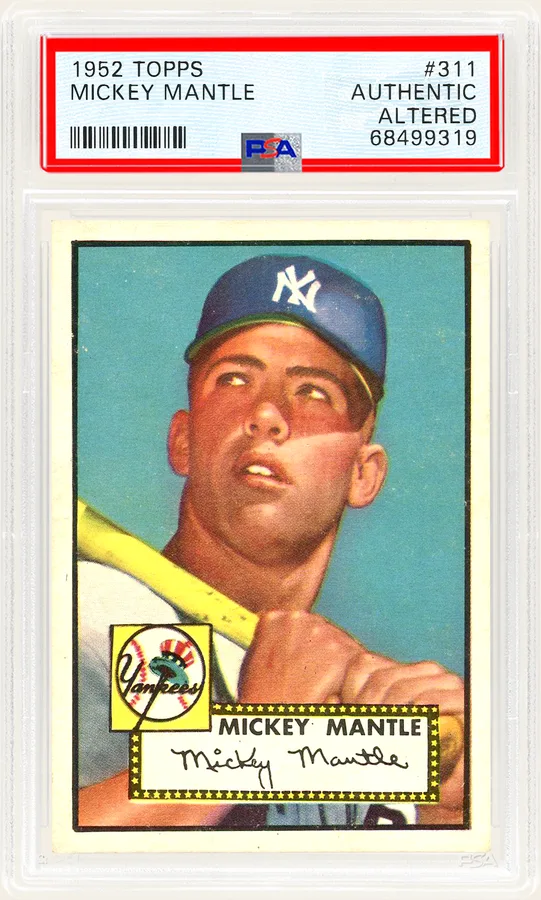 Image: PSA
An Authentic Altered label tells you the grader found an alteration. A plain Authentic label on PSA is less clear than it looks. PSA's guarantee page says "the Guarantee does not differentiate between the "Authentic" and "Authentic Altered" designations," and "Items labeled "Authentic" must be viewed as potentially interchangeable with "Authentic Altered," and therefore equal in value and not subject to compensation through the guarantee policy." CGC's guarantee says a collectible "is authentic (unless stated otherwise on the CGC label)."
For numeric grades, PSA's guarantee "assures the accuracy of the grade assigned to any PSA graded card as long as it remains in its tamper-evident holder." Grades also involve judgment: PSA says graders "reserve the right, based on the strength or weakness of the eye appeal, to make a judgment call on the grade of a particular card." How the major graders compare on price and turnaround is in our sports card grading guide.
Community: when your own card comes back N1
Collectors who buy raw vintage cards run into this. In a 2016 Collectors Universe thread titled "N1 Evidence of trimming," ugaskidawg wrote about a 1954 Topps card bought raw: "I have seen many authentic but altered cards, but this is the first time one of mine has come back this way." (thread)
The older thread on spotting trims is still a useful reality check on measuring: norty's warning that "Comparative sizing is not a consistently good approach to detecting trims" sat next to Virtualizard's careful measurements of 27 graded cards. (thread) Both posts are more than a decade old; they describe collector practice, not current grader policy.
Our take
Based on the grader rules and cases cited above: check the edges against PSA's four red flags first, and use a ruler only as a second opinion, since factory miscuts and undersized issues fail a ruler test too. If a raw card shows more than one flag, our view is that passing is often the cheaper choice, because PSA charges the fee on an N1 card either way. When buying a slab, read the words on the label: "Authentic Altered" is a disclosed alteration, and PSA itself says a plain "Authentic" should be treated as potentially the same thing.
Frequently Asked Questions
The six questions above cover how to tell if a card is trimmed, PSA's N1 code, Authentic Altered, whether an Authentic slab can hold a trimmed card, measuring, and what PSA charges for a rejected card.
How can you tell if a sports card is trimmed?
Look at the edges first. PSA's N1 definition lists four signs of a card that appears trimmed: a hooked appearance along the edge, unusually sharp or uncommon edges for the issue, an inconsistent tone to the color of the edge, or a wavy, unnatural look. Then compare the card with a known untrimmed copy from the same set.
What does N1 mean on a PSA submission?
N1 is PSA's no-grade code for Evidence of Trimming, used when a card's edge appears to have been altered. PSA says it will not grade cards that bear evidence of trimming, and you are charged the grading fee either way. The card can be slabbed as Authentic Altered at the grader's discretion if you listed AA as the minimum grade.
What does Authentic Altered mean on a slab?
It means the grader judged the card genuine but altered. CGC says it prints Authentic Altered in the grade box when a card is authentic but has been altered, with recoloring and trimming as examples. PSA uses the same designation for several no-grade codes, including N1 trimming, at the grader's discretion.
Can an Authentic PSA slab hold a trimmed card?
PSA's guarantee text says items labelled Authentic must be viewed as potentially interchangeable with Authentic Altered, and therefore equal in value and not subject to compensation through the guarantee. A plain Authentic label is not a statement that the card is unaltered.
Is measuring a card enough to prove it is trimmed?
No. Standard cards are 2-1/2 by 3-1/2 inches, and a ruler can flag a card that is clearly short. But a member of the Collectors Universe forum wrote in 2004 that comparative sizing is not a consistently good approach, and that vending cards were cut smaller and differently. PSA also separates factory miscuts (N8) and undersized cards (N6) from trimming (N1).
Does PSA charge for a card it rejects as trimmed?
Yes. PSA's N1 entry says you will be charged the applicable grading fee in either case, whether the card is returned ungraded or slabbed as Authentic Altered. For N6 (minimum size) and N8 (miscut), PSA says you are not charged unless the card is encapsulated as Authentic.
How we checked this
PSA's grading standards (no-grade codes, hand-cut rules, eye appeal) and PSA's trading card grading page (Express tier and Grader Notes) were read on October 11, 2026, as were PSA's guarantee and About pages, PSA's June 2021 customer update on qualifiers, CGC's grading scale, FAQ, guarantee and a CGC news post on Authentic Altered. The standard card size comes from Ultra PRO's toploader page, re-read the same day. The Mastro case comes from a 2013 New York Daily News article; the Justice Department's own releases did not load for us. Forum quotes were read on Collectors Universe on October 11. The diagram and chart are RookieDesk graphics built only from PSA's wording. We did not examine or grade any card ourselves. SGC's grading pages did not load, so this guide makes no claims about SGC. Full source table: data/sources/how-to-spot-trimmed-sports-cards.sources.md.
References
- PSA, grading standards: https://www.psacard.com/gradingstandards
- PSA, trading card grading services and prices: https://www.psacard.com/services/tradingcardgrading
- PSA, financial guarantee: https://www.psacard.com/financialguarantee
- PSA, customer update (June 7, 2021), qualifiers: https://www.psacard.com/articles/articleview/10428/psa-customer-update-june-2021
- PSA, about PSA: https://www.psacard.com/info/about-psa
- CGC Cards, grading scale: https://www.cgccards.com/card-grading/grading-scale/
- CGC Cards, FAQ on CGC grades: https://www.cgccards.com/about/help-center-faqs/cgc-cards-grading/about-cgc-grades/
- CGC Cards, guarantee: https://www.cgccards.com/card-grading/cgc-guarantee/
- Ultra PRO, 3" x 4" regular toploaders: https://www.ultrapro.com/products/3-inch-x-4-inch-clear-regular-toploaders-25ct-for-standard-size-cards
- New York Daily News, "Bill Mastro admits cutting T206 Honus Wagner card, pleads guilty to mail fraud" (Oct 11, 2013): https://www.nydailynews.com/2013/10/11/bill-mastro-admits-cutting-t206-honus-wagner-card-pleads-guilty-to-mail-fraud/
- Collectors Universe forums, "Card trimming" (2004) and "N1 Evidence of trimming" (2016): https://forums.collectors.com/discussion/270292/card-trimming
Related Reading
- CGC Grading Fees 2026: Every Tier and Price for Sports Cards: what CGC charges, if you want a second grader's opinion on a suspect card.
- How to Store Sports Cards: Sleeves, Toploaders and Humidity: keeping edges and corners intact so a card never needs "help."
- SGC Grading Fees 2026: Every Tier After the September Change: SGC's price table for comparison.
About the author

Editorial desk
The RookieDesk desk. We read the paperwork before you open the box: Topps' checklists and odds sheets, the box art, grader fee pages. Every number links to its source and carries the date we checked it.
Keep reading
What Is a Pop Report? PSA, SGC and CGC Population Explained
Guides · 8 min
CGC Grading Fees 2026: Every Tier and Price for Sports Cards
Guides · 9 min
SGC Grading Fees 2026: Every Tier After the September Change
Guides · 8 min
Sports Card Grading 2026: PSA vs SGC vs CGC vs Beckett
Guides · 14 min
PSA Grading Fees 2026: Every Tier, Price and Turnaround
Guides · 8 min
How to Store Sports Cards: Sleeves, Toploaders and Humidity
Guides · 9 min
2026 Panini Donruss Football: Box, Inserts and Release Date
Guides · 8 min
2026 Panini Obsidian Football: Box, Case Hits and Release
Guides · 8 min
Disclaimer
RookieDesk publishes data, not investment or financial advice. Odds are the manufacturer's published odds, not a promise of what any one box contains. Checklists, release dates, grading fees and prices change after publication; each one here carries the date we checked it. Confirm critical details with the manufacturer, grader or seller before you buy or submit. RookieDesk is independent and not affiliated with any card manufacturer, league or players association, and carries no affiliate links, ads or sponsored posts; see our independence note. Articles are researched and written with AI tools, and every fact is checked against its cited source before publishing; see how we use AI.