Guides
What Does Gem Mint Mean? A 10 at PSA, a 9.5 at Beckett
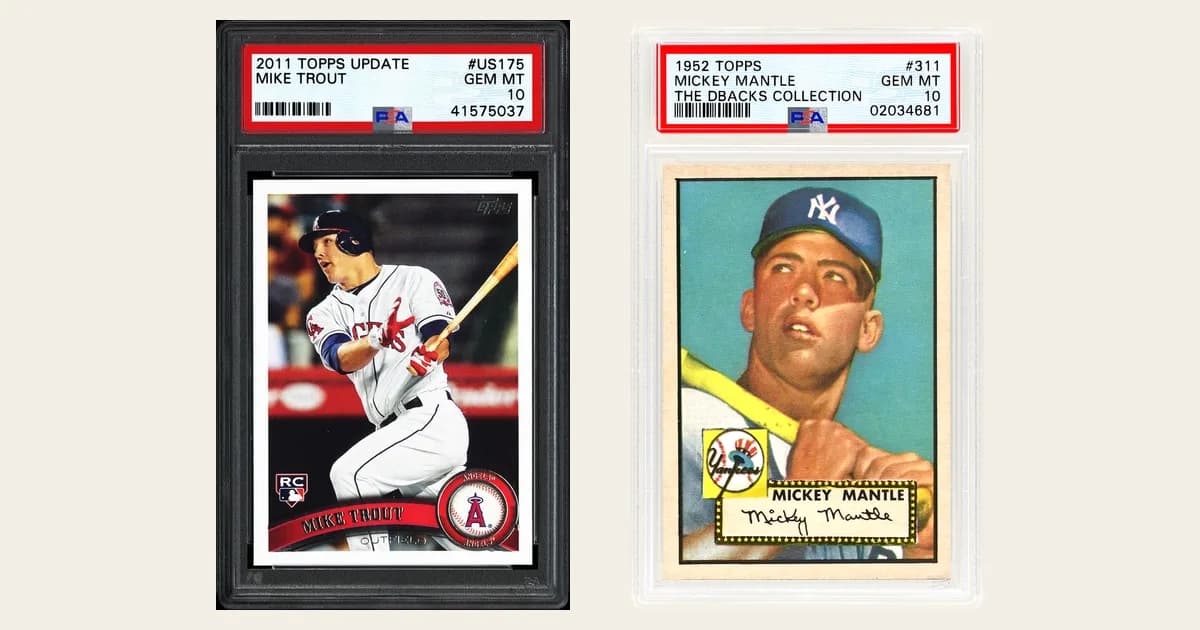
What does gem mint mean? The grade just under perfect: a 10 at PSA, CGC and SGC but a 9.5 at Beckett. Three of the four put a Pristine 10 above it.
TL;DR: Gem Mint is the "virtually perfect" grade (PSA's words). It is PSA's top grade, but CGC and SGC each put a Pristine 10 above their Gem Mint 10, and Beckett's archived scale puts Pristine 10 above Gem Mint 9.5. The usual gap is centering: about 55/45 on the front for Gem Mint, 50/50 for Pristine. CGC now shows its old Gem Mint 9.5s online as Gem Mint 10.
Updated Oct 31, 20267 min readBy RookieDesk Editorial
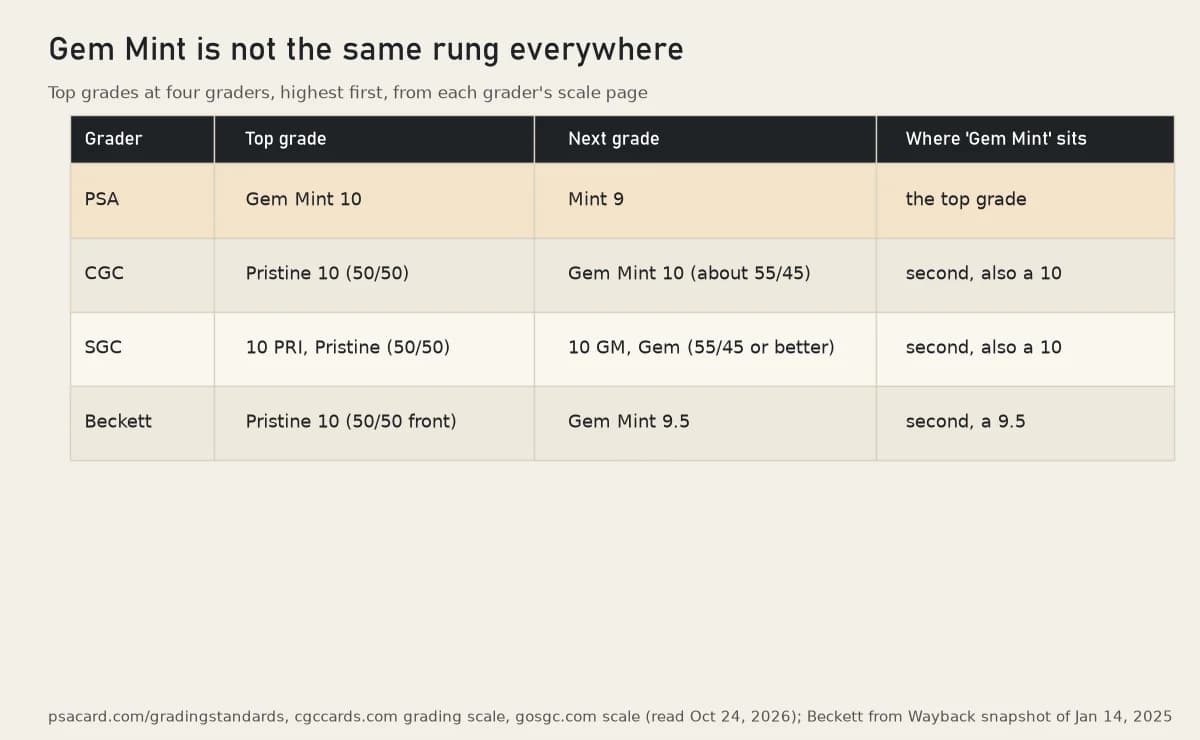
The answer to what does gem mint mean depends on the slab: it is the grade name for a card with no visible flaws, and it is a 10 at PSA, CGC and SGC but a 9.5 at Beckett. If you are comparing two graded copies, the number alone does not tell you the same thing. CGC even defines its Gem Mint 10 as a 10 that missed Pristine.
What does gem mint mean? (quick answer)
It is the grader's label for a card with sharp corners, full gloss and good centering, with at most a tiny print flaw. At PSA it is the top of the scale. At CGC, SGC and Beckett, a Pristine grade sits above it.
Key Takeaways
- PSA: Gem Mint 10 is the top, "a virtually perfect card," about 55/45 front and 75/25 back centering.
- CGC: Pristine 10 (50/50) above Gem Mint 10 (about 55/45); old Gem Mint 9.5s now show as Gem Mint 10.
- SGC: 10 Pristine (50/50) above 10 Gem (55/45 or better); 9.5 is Mint+.
- Beckett: Pristine 10 above Gem Mint 9.5, on an archived scale page; no live Beckett scale page in October.
- Same words, different rungs: compare the label name and the grader, not just the number.
Overview: one name, four scales
Every major grader uses the words Gem Mint, and none of them uses it the same way. PSA's grading standards page heads its top grade "GEM-MT" and "PSA 10" and calls it "a virtually perfect card." Its attributes: "four perfectly sharp corners, sharp focus and full original gloss."
CGC, SGC and Beckett add a grade above it. That is why a "10" on its own is half a fact. This guide sets the four scales side by side from each grader's own pages (Beckett's from archived copies); it does not rank graders or say which slab sells for more.
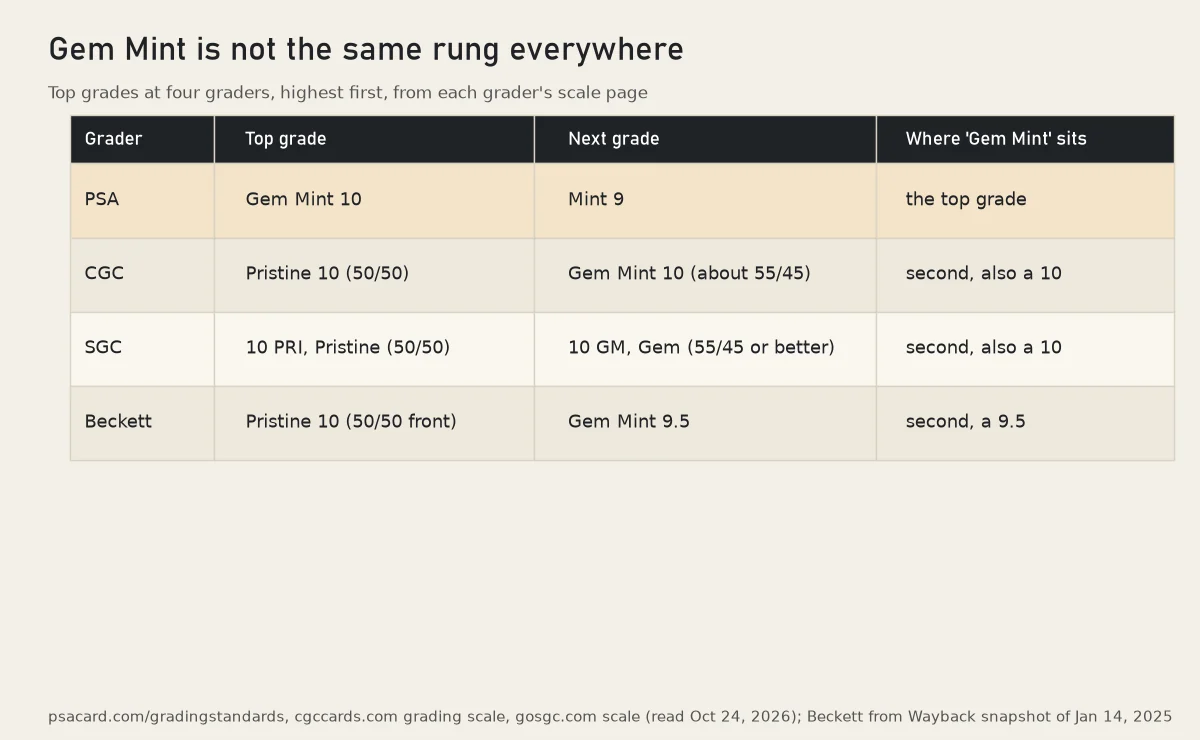 Chart: RookieDesk, from psacard.com/gradingstandards, cgccards.com grading scale, gosgc.com grading scale (read Oct 24) and Beckett's archived grading standards (Jan 2025 snapshot)
Analysis: gem mint at PSA, CGC, SGC and Beckett
PSA: Gem Mint 10 is the ceiling
PSA has no grade above it. The page allows "a slight printing imperfection, if it doesn't impair the overall appeal of the card," but no staining "of any kind." Centering must be within "approximately 55/45 percent on the front, and 75/25 percent on the reverse." PSA also keeps a judgment call: graders "reserve the right, based on the strength or weakness of the eye appeal," to decide.
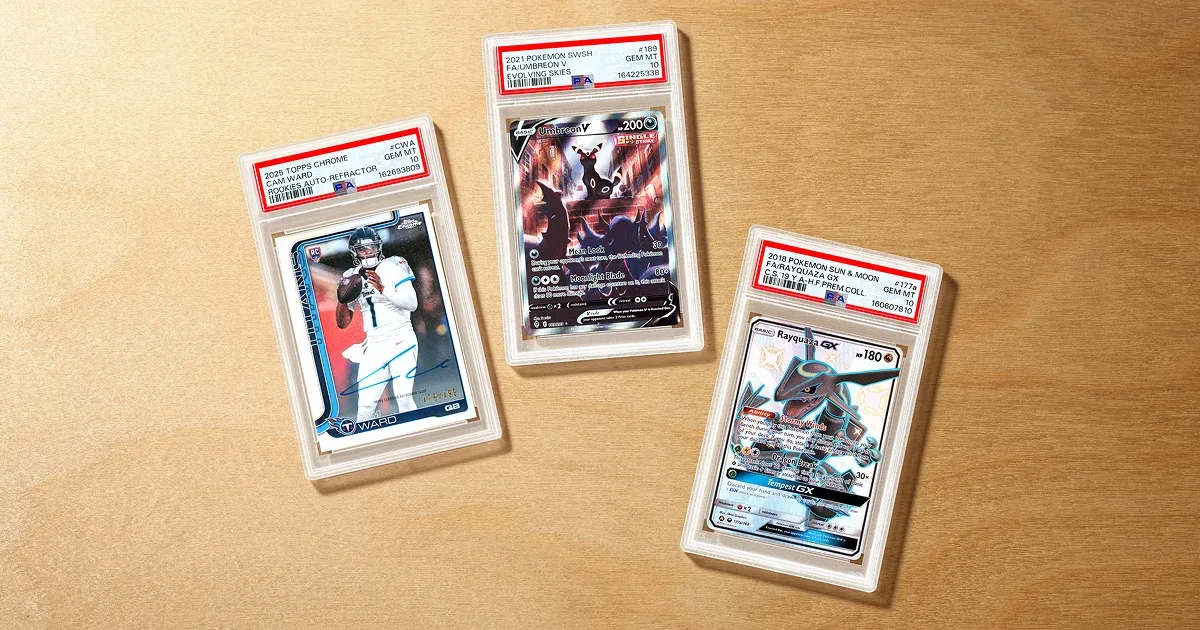 Image: PSA
GODEEPER: Every PSA label from 10 to 1, plus the qualifiers that can follow a grade. PSA Grading Scale Explained →
CGC: Gem Mint 10 is the 10 that missed Pristine
CGC's scale is the most candid about the gap. "A Gem Mint 10 is a card that has received a 10 grade overall; however, one of the grading criteria does not meet the requirements of a Pristine 10." Its corners "appear perfect to the naked eye and Mint+ under 10x magnification." Pristine 10 asks for more: "The centering is 50/50," and the label is reserved for cards "flawless under 10-times magnification."
CGC also rewrote its history. After merging its old trading card scale into CGC Cards, its FAQ says cards "previously graded Gem Mint 9.5 are automatically updated online to appear as Gem Mint 10." And "The Perfect 10 grade, which was seldom used, is no longer being assigned." Online, an old 9.5 now reads 10. Same card.
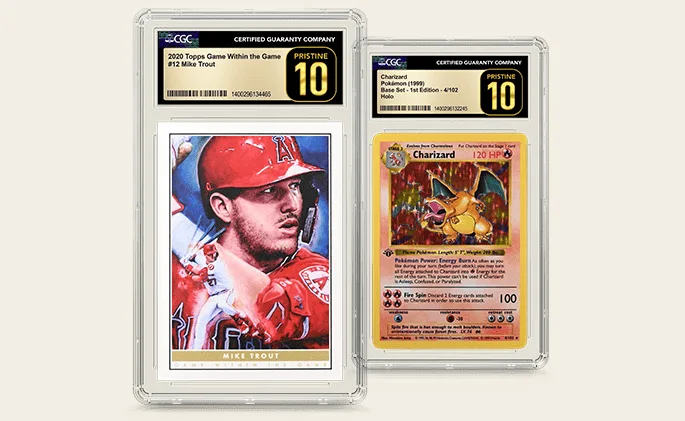 Image: CGC Cards
SGC: 10 PRI above 10 GM
SGC's scale page, rendered October 24, lists "10 PRI" first: a "virtually flawless" card with "50/50 centering." Next is "10 GM," quality "GEM," with "55/45 or better centering" and no visible wear; "A slight print spot visible under close scrutiny is allowable." Below that, 9.5 is Mint+, a card that "at first glance appears to be Gem Mint 10" but has a tiny flaw. SGC's 9 needs "60/40 or better centering."
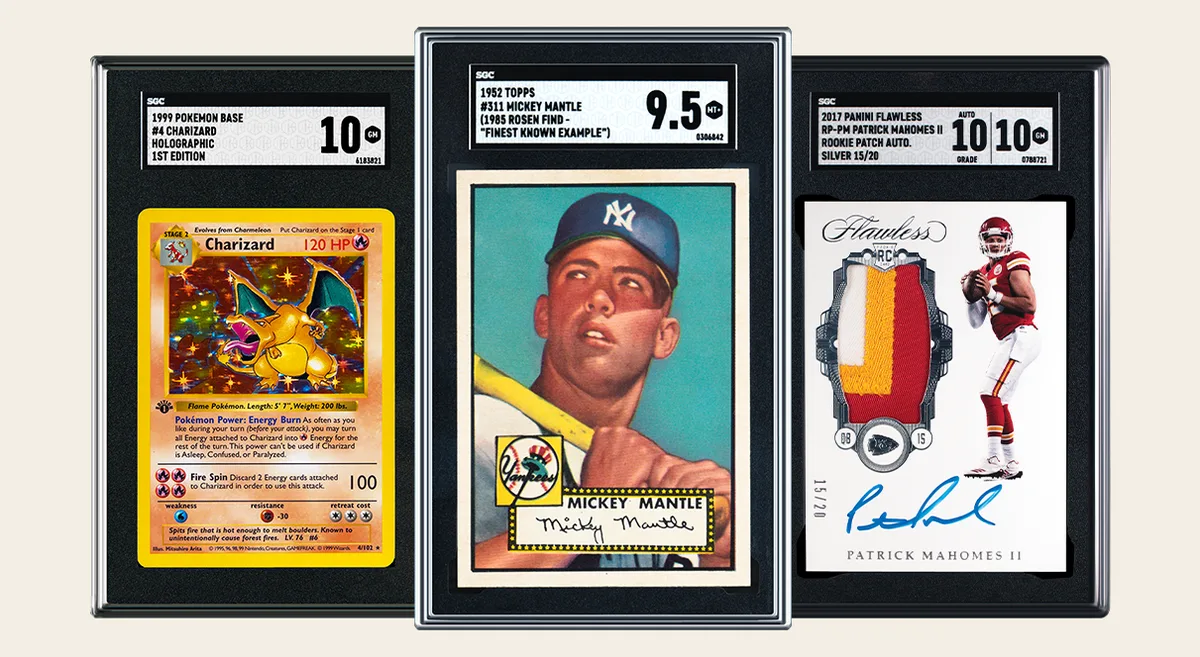 Image: SGC
Beckett: Gem Mint is 9.5
Beckett is the odd one out. Its archived grading standards (January 2025 snapshot) list "10 Pristine," then "9.5 Gem Mint," then "9 Mint," in "half-point increments." Pristine needs "50/50 all around on front. 55/45 or better on back." A February 2026 snapshot of Beckett's grading page describes the label colors: "BLACK Perfect Pristine 10's," "GOLD Pristine 10 & Gem Mint 9.5." On October 19, beckett.com still sent visitors to a status page, which listed online card grading as available again but showed no scale.
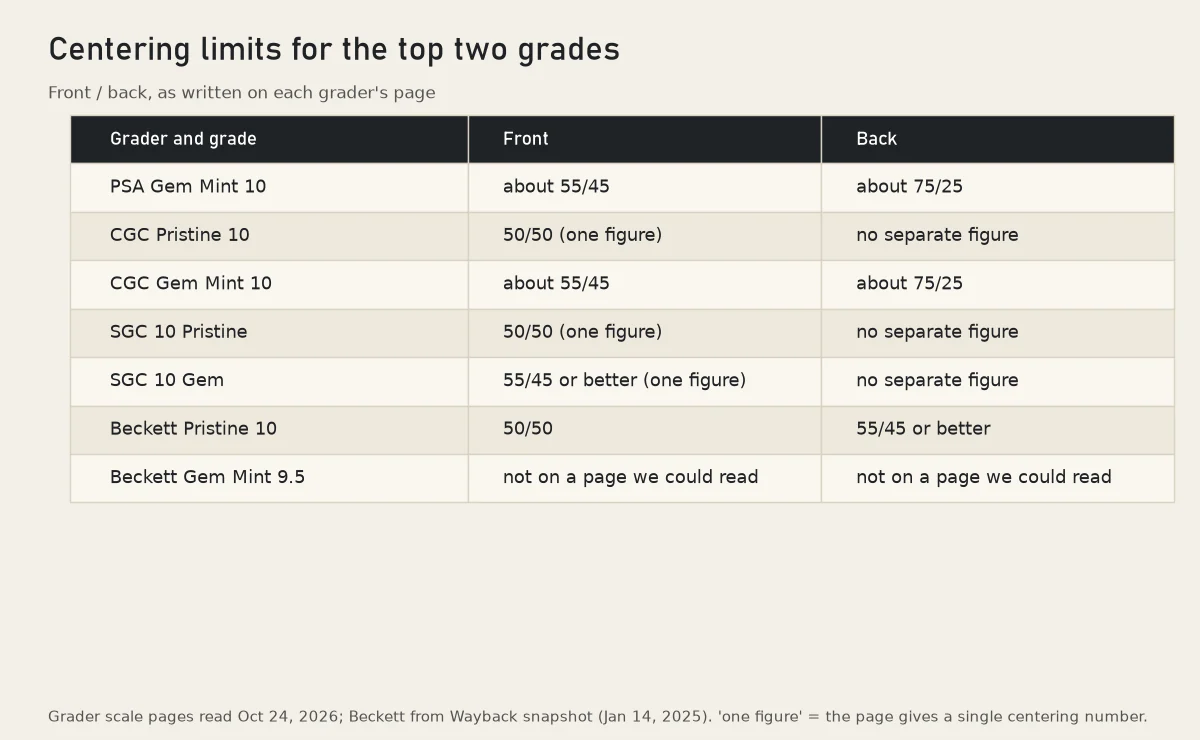 Chart: RookieDesk, from the four graders' scale pages (Beckett from archived snapshots); 'no separate figure' where a page gives a single number
Desk note: in our grading fee table, the lowest listed per-card tier was CGC Bulk at $17 and SGC Standard at $50 (both checked October 14), and PSA Value at $39.99, which PSA reopened on October 29 (its services page read October 31); Beckett's status page, read October 19, listed online card grading as available again with no tiers or prices. Fees and status by grader are on our grading status page.
Community: gem mint in practice
On r/psagrading in October, a collector posted two slabs under the title "How are these different grades?" One reply, from u/Spiceynuggetz, was one line: "Because one of them has a 9 (mint) and the other one has a 10 (gem mint)" (comment).
Because one of them has a 9 (mint) and the other one has a 10 (gem mint)
Not everyone chases the top rung. In a thread titled "I stopped treating anything below a 10 like a bad result," u/QuickerInferior wrote: "the 8s and 9s are where the real collecting happens anyway. chasing 10s turns it into a spreadsheet exercise instead of just enjoying what you have" (comment).
What the documents say: CGC and SGC write down the gap between a 9 and a 10 grade by grade, and both put one more rung above Gem Mint.
Our take
Read gem mint with the grader's name attached: at PSA it is the top, elsewhere it is second. CGC, SGC and Beckett each reserve 50/50 centering for a Pristine 10, while PSA's Gem Mint 10 and CGC's and SGC's Gem 10 allow about 55/45.
If you compare slabs across graders, match the label words ("GEM MT," "GM," "Pristine") before the number; if you submit for a 10, the grader's own centering line is the first thing to check against the card.
What we don't know yet: Beckett's current scale and its centering rule for Gem Mint 9.5, which was not on any live Beckett page we could read in October. We will add them when beckett.com publishes them again.
Read from: PSA grading standards, CGC Cards grading scale and merger FAQ, SGC grading scale (October 24), Beckett grading standards and grading page (Wayback snapshots of January 2025 and February 2026). Data, not investment advice.
Frequently Asked Questions
The six questions above cover the definition, whether gem mint is the top grade, gem mint vs pristine, BGS 9.5 vs PSA 10, centering and CGC's old 9.5s.
What does gem mint mean?
It is the grade name for a card with no visible flaws, one step below or equal to the top of the scale. PSA calls its Gem Mint 10 'a virtually perfect card.' At PSA, CGC and SGC it is a 10; at Beckett it is 9.5.
Is gem mint the highest grade?
Only at PSA, whose top label is Gem Mint 10. CGC puts Pristine 10 above Gem Mint 10, SGC puts 10 Pristine above 10 Gem, and Beckett puts Pristine 10 above Gem Mint 9.5, with a Black label for what it calls 'Perfect Pristine 10's.'
What is the difference between gem mint and pristine?
Mostly centering and magnification. CGC's and SGC's Pristine 10 needs 50/50 centering; their Gem Mint 10 allows about 55/45 on the front. CGC defines Gem Mint 10 as a 10 where one criterion 'does not meet the requirements of a Pristine 10.'
Is a BGS 9.5 the same as a PSA 10?
They share the name Gem Mint, not the scale. Beckett's archived scale lists 9.5 as Gem Mint with Pristine 10 above it; PSA's Gem Mint 10 is its top grade. The centering rules for Beckett's 9.5 were not on any Beckett page we could read.
What centering does a gem mint 10 need?
PSA: about 55/45 on the front and 75/25 on the back. CGC Gem Mint 10: about 55/45 and 75/25. SGC 10 Gem: 55/45 or better, with no back figure on its scale page. CGC's and SGC's Pristine 10 ask for 50/50; Beckett's asks for 50/50 on the front and 55/45 on the back.
What happened to CGC Gem Mint 9.5?
CGC merged its old trading card scale into CGC Cards. Its FAQ says cards 'previously graded Gem Mint 9.5 are automatically updated online to appear as Gem Mint 10,' and that Perfect 10 'is no longer being assigned.'
How we checked this
The desk read PSA's grading standards page, CGC's grading scale and its CGC Cards merger FAQ on October 24. SGC's scale page loads its text with JavaScript, so we rendered it in a browser on October 24 and copied each grade's description. Beckett's pages showed a maintenance notice, so Beckett wording comes from Wayback Machine snapshots of its grading standards (January 14, 2025) and grading page (February 12, 2026), read October 11. Fees come from our grading fee table, checked October 14. Reddit comments were read through Arctic Shift. We submit no cards and report no grades of our own.
PATCH: Updated Oct 31, 2026: PSA reopened its Value tier on October 29 at $39.99, so the Desk note's lowest PSA price is now Value, not Standard at $59.99.
References
- PSA, Grading Standards: https://www.psacard.com/gradingstandards
- CGC Cards, Grading Scale: https://www.cgccards.com/card-grading/grading-scale/
- CGC Cards, CGC Cards merger FAQ: https://www.cgccards.com/about/help-center-faqs/about-cgc-cards/cgc-cards-merger/
- SGC, The SGC Grading Scale: https://gosgc.com/card-grading/scale
- Beckett, Grading Standards (Wayback snapshot, Jan 14, 2025): https://web.archive.org/web/20250114070557/https://www.beckett.com/grading-standards
- Beckett, Grading (Wayback snapshot, Feb 12, 2026): https://web.archive.org/web/20260212062931/https://www.beckett.com/grading
Related Reading
- BGS vs PSA Grading: subgrades, label colors and why a 9.5 and a 10 are not a straight swap.
- Sports Card Condition Guide: how to check centering, corners, edges and surface before you submit.
- What Is Crossover Grading?: moving a slab from one grader to another, and the minimum grade rules.
- CGC Grading Fees 2026: the tiers behind CGC's Pristine and Gem Mint labels.
About the author

Editorial desk
The RookieDesk desk. We read the paperwork before you open the box: Topps' checklists and odds sheets, the box art, grader fee pages. Every number links to its source and carries the date we checked it.
Keep reading
Card Condition Guide: Centering, Corners, Edges and Surface
Guides · 9 min
How to Submit Cards to PSA: Step-by-Step Guide for 2026
Guides · 8 min
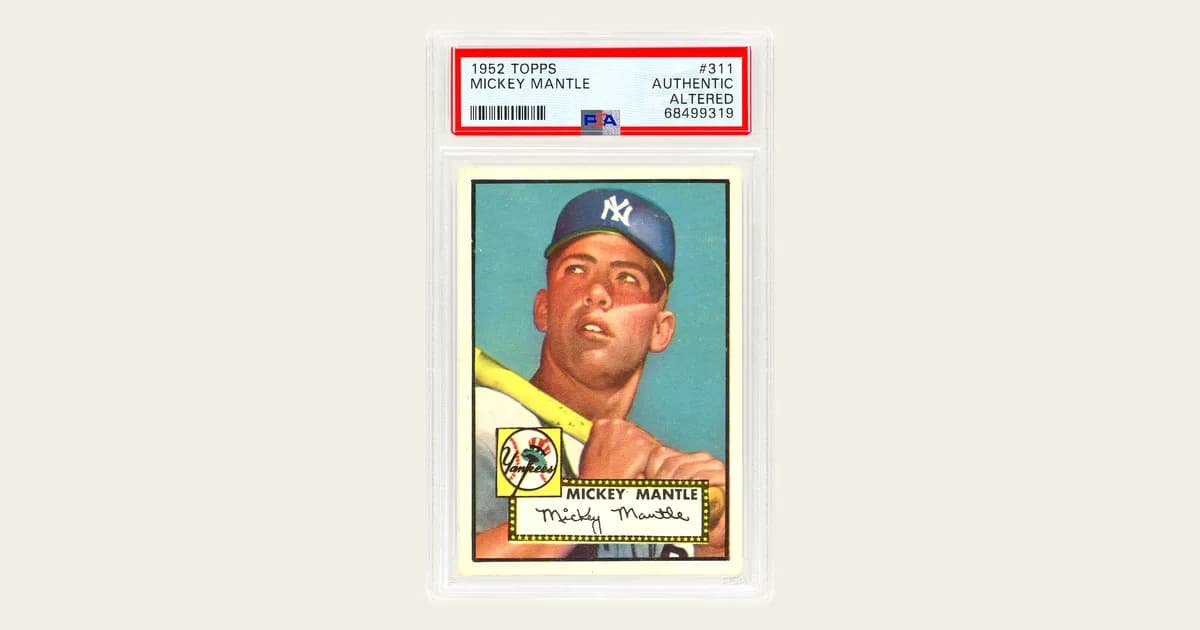
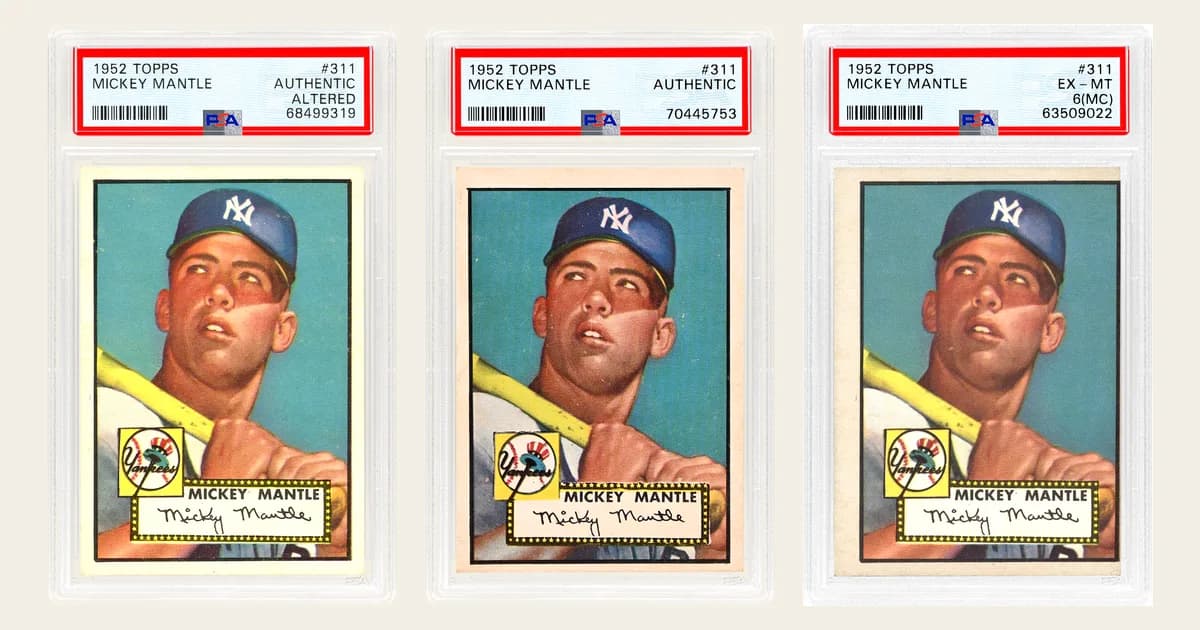
How to Clean Sports Cards: What PSA and CGC Call Altered
Guides · 8 min
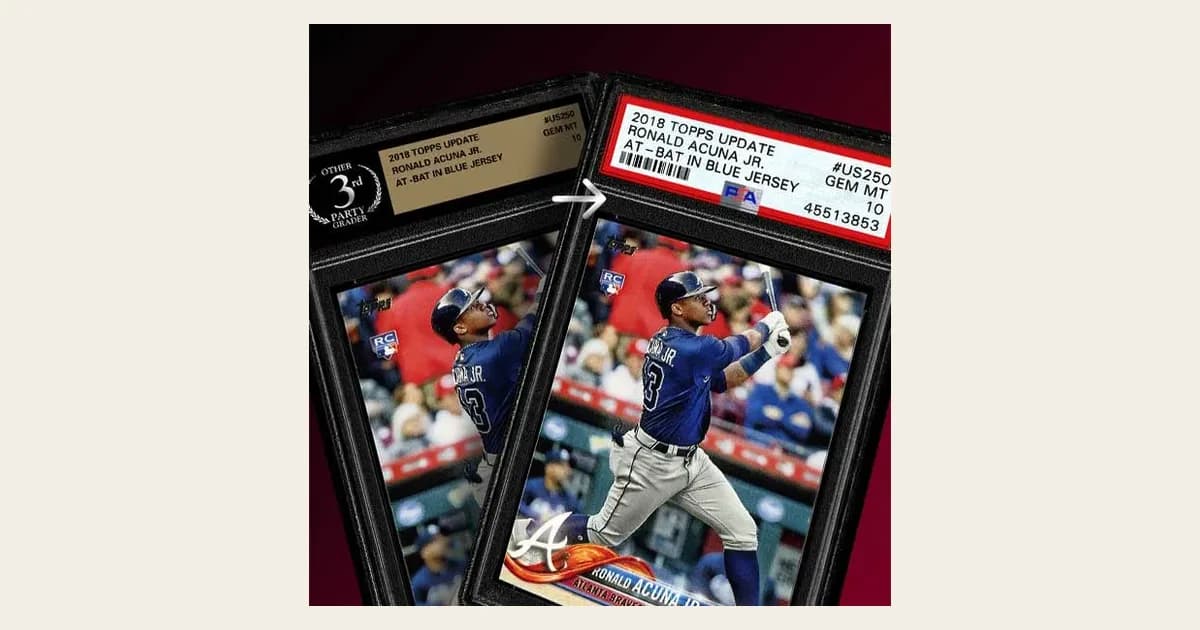
Crossover Grading: How PSA, CGC and SGC Handle Other Slabs
Guides · 9 min
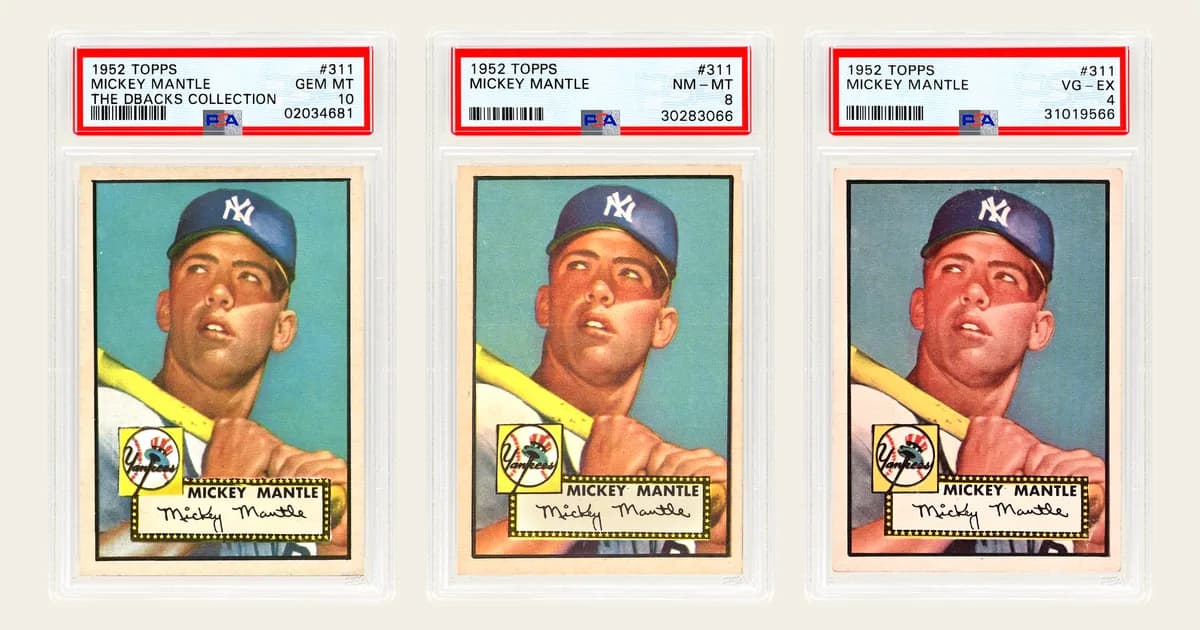
BGS vs PSA: Subgrades, Black Label and Grading Scales
Guides · 10 min
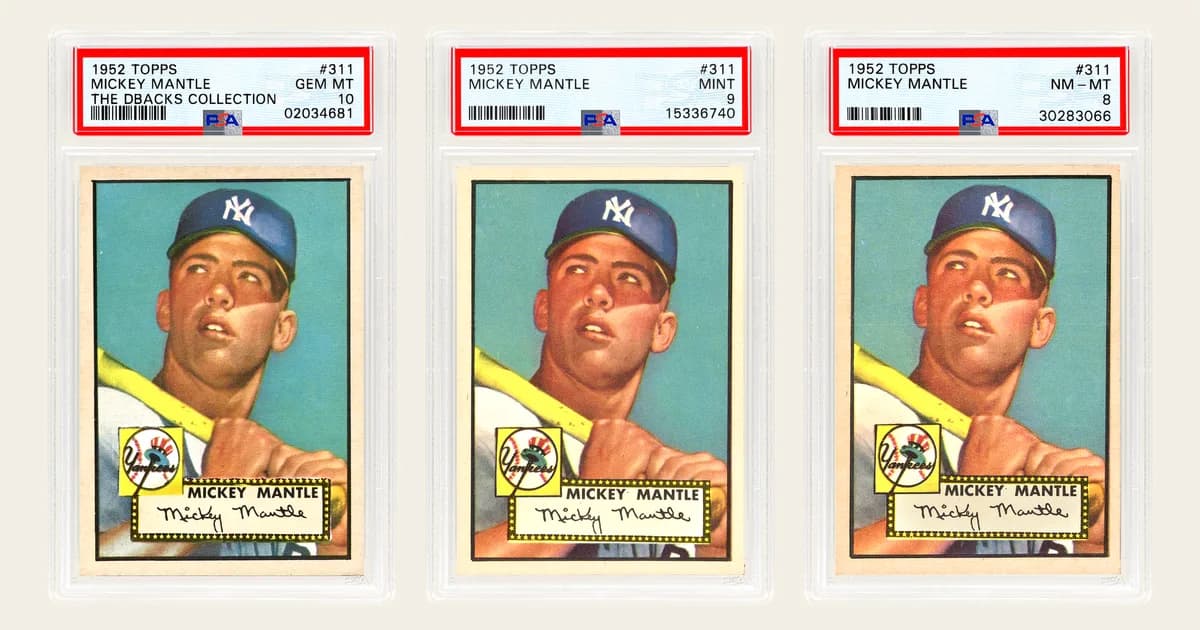
PSA Grading Scale Explained: What PSA 10, 9 and 8 Mean
Guides · 9 min
How to Spot a Trimmed Sports Card: PSA and CGC Red Flags
Guides · 8 min
What Is a Pop Report? PSA, SGC and CGC Population Explained
Guides · 8 min
Disclaimer
RookieDesk publishes data, not investment or financial advice. Odds are the manufacturer's published odds, not a promise of what any one box contains. Checklists, release dates, grading fees and prices change after publication; each one here carries the date we checked it. Confirm critical details with the manufacturer, grader or seller before you buy or submit. RookieDesk is independent and not affiliated with any card manufacturer, league or players association, and carries no affiliate links, ads or sponsored posts; see our independence note. Articles are researched and written with AI tools, and every fact is checked against its cited source before publishing; see how we use AI.