Guides
Card Show Tips for Beginners: What to Bring and How to Buy
Card show tips for beginners from the National's FAQ, PSA's show and price tools and collector advice on cash, comps, slab checks and on-site grading.
TL;DR: Bring cash (the 2026 National listed 15 ATMs throughout the show), a phone and a written list with recent sale prices. Take a lap before buying, check comps at the table, and negotiate: in an r/sportscards thread of show tips, commenters advised looking up comps and making offers. Run any slab's cert through PSA's Cert Verification before paying. PSA takes submissions at some events, but check its schedule for which services each event offers.
8 min readBy RookieDesk Editorial
Card show tips start with a plan: what you want, what it sells for, and how you will pay. Shows reward buyers who check prices on the spot and walk away when the number is wrong. This guide uses the National Sports Collectors Convention's own pages, PSA's show and price tools, and advice collectors posted on r/sportscards, all read on October 11, 2026.
Card show tips: the short version (quick answer)
Set a budget, write down the cards you want with their recent sale prices, carry cash, and walk the whole floor before you spend. At a table, look up the comp, make an offer, and be ready to leave. For a slab, verify the cert number before money changes hands.
Key Takeaways
- Cash: the National's FAQ lists "15 ATM machines" throughout the show; collectors on r/sportscards put it shorter: "Cash is King!"
- Comps: "Always look up comps and negotiate. Prices are always inflated but seller's are prepared to come down from asking," one r/sportscards commenter wrote.
- Price tools: PSA suggests searching sale results with "the year, manufacturer and subject," and checking "the number of bids" as well as the final price.
- Slabs: PSA lists "Cert Verification" among its research tools. Run the number before you pay.
- Grading on site: PSA takes submissions at its events; its FAQ says the show schedule "lists the services we will be performing at each event."
Overview: card show tips before you go
Most of the work happens before you walk in. The table pairs each step with where it comes from.
| Step | What to do | Source |
|---|---|---|
| Budget | "Set a budget for the event and stick to it." | r/sportscards commenter |
| List | "make a list of the cards you want with the comps" | r/sportscards commenter |
| Cash | Carry it; the National lists 15 ATMs on site | nsccshow.com FAQ |
| Phone | PSA's app: "Scan to research," plus "price estimates" and "sales history" | psacard.com |
| Cards to trade | Keep them secure; vendors usually ask for what they want | r/sportscards commenters |
| Grading | Check which services PSA offers at that event | psacard.com FAQ |
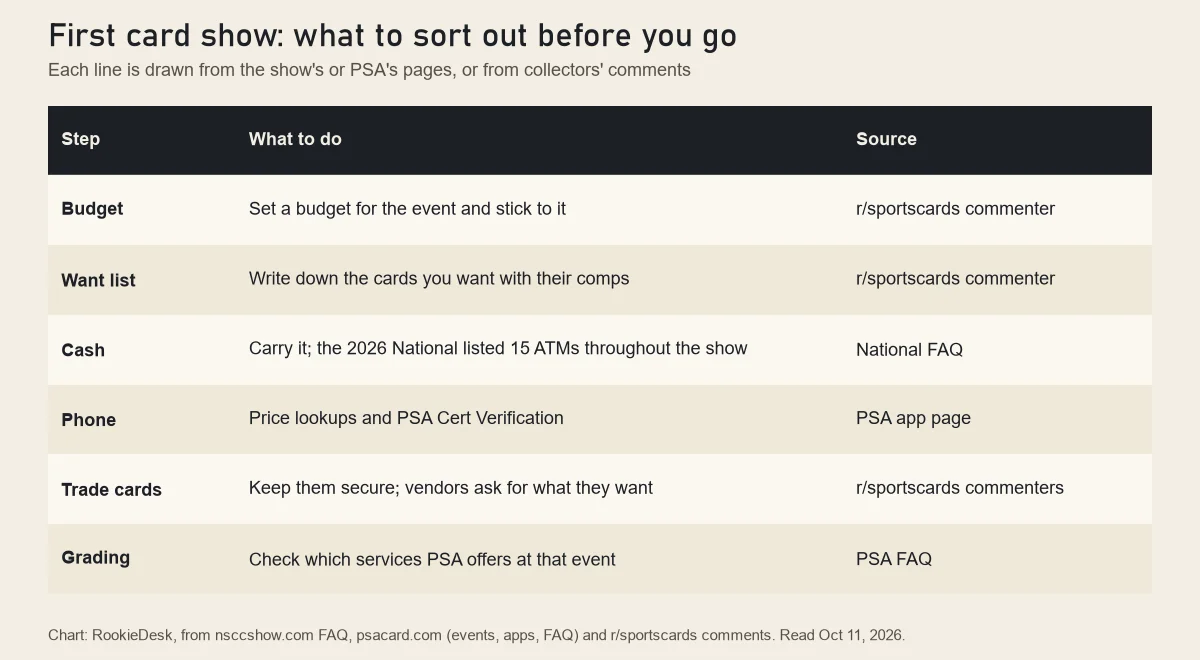 Chart: RookieDesk, from the National's FAQ, PSA's events, app and FAQ pages, and r/sportscards comments (read October 11, 2026)
Analysis: what the biggest show's own rules tell you
The National Sports Collectors Convention publishes detailed visitor rules, and they show what a big show expects. The 2026 edition ran "July 29th - August 2nd, 2026" at the Donald E. Stephens Convention Center in Rosemont, Illinois. General admission was $30 a day, after an advance price of $25 until June 30, and "Children aged 12 and under can enter for free throughout the week" with a paying adult. "All ticket sales are final. No refunds or exchanges are permitted."
The FAQ answers the practical questions: "15 ATM machines are conveniently located throughout the show," "Outside food and drinks are not allowed," and "Parking fees, typically $15, vary per event," with "Cash or credit" accepted for parking. Hours ran from "2 pm - 8 pm" on the opening Wednesday to "10 am - 4 pm" on the final Sunday. For a local show, check the organizer's page; the National's list is a good template for what to ask.
Analysis: checking prices at the table
A card show sticker is an asking price. One r/sportscards commenter, u/FishGoldenLite, put it plainly: "Always look up comps and negotiate. Prices are always inflated but seller's are prepared to come down from asking." Another, u/coolestkid, reminded a first-timer: "You can always search for comps at the show. It's not going to run away."
PSA's card value page lays out a lookup method. For sold prices, "It is best to include the year, manufacturer and subject of your card in your search," and "In addition to the final sale price, also check the number of bids on the auction listing." Its Auction Prices Realized pulls results "from all the top auction houses like ebay to Heritage." For graded cards, PSA tells you to "Search for your card by set and then look up the price by grade."
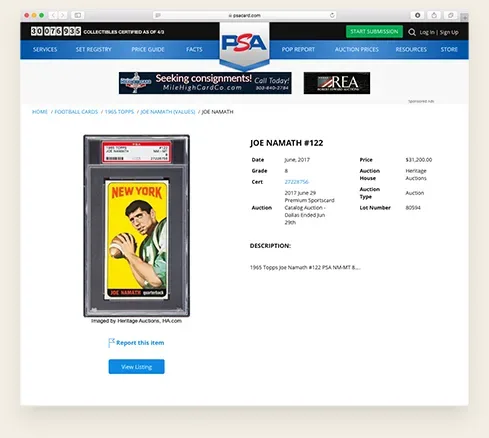 Image: PSA (screenshot of Auction Prices Realized; card photo credited on the page to Heritage Auctions)
Know what each number means. PSA says its Price Guide covers "PSA-certified/graded collectibles" only, and "No subjective pricing surveys or price ranges of ungraded cards are ever included." For a raw card, PSA suggests you first "compare it to PSA's Grading Standards." Our card condition guide covers what to look at on a raw card before you trust a raw price.
GODEEPER: How eBay's fees and rules change the price a seller can take. How to Sell Sports Cards on eBay: Fees, Photos and Shipping →
Analysis: checking a slab before you pay
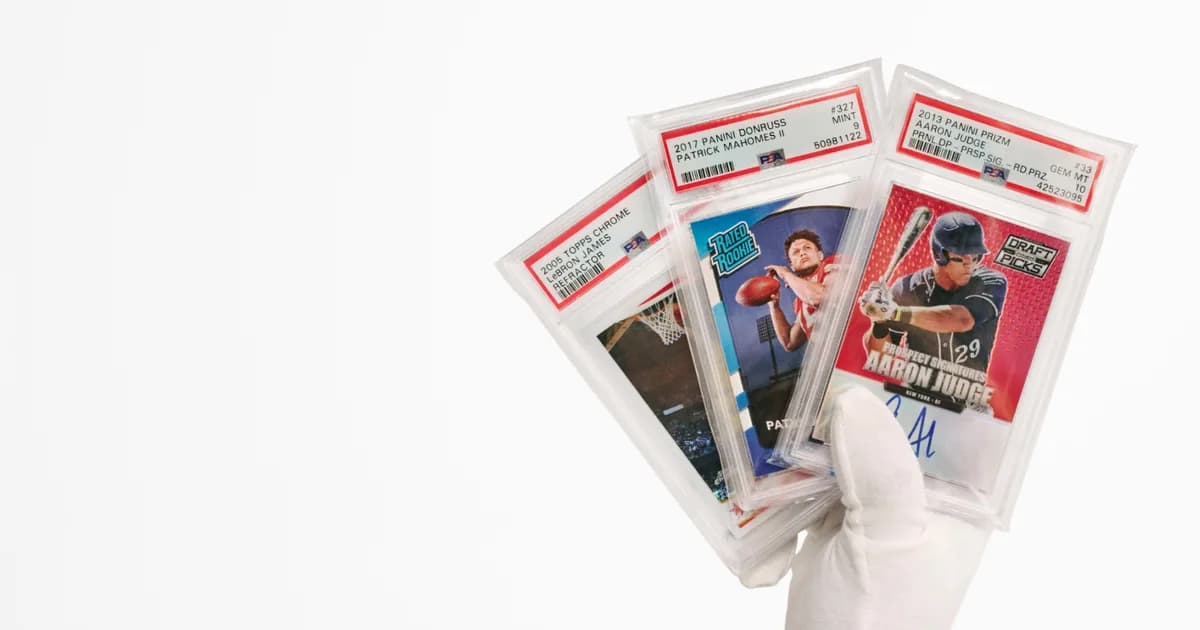
Shows are full of graded cards, and a cert lookup takes a minute. PSA lists "Cert Verification" among its research tools, and its FAQ says PSA's imaging is "extremely useful for collectors looking to verify the details of an item, including its cert number, before making a purchase." Compare the card in your hand with PSA's record, not just the number on the label. Our guide on how to spot fake sports cards lists the holder and label checks PSA and CGC publish.
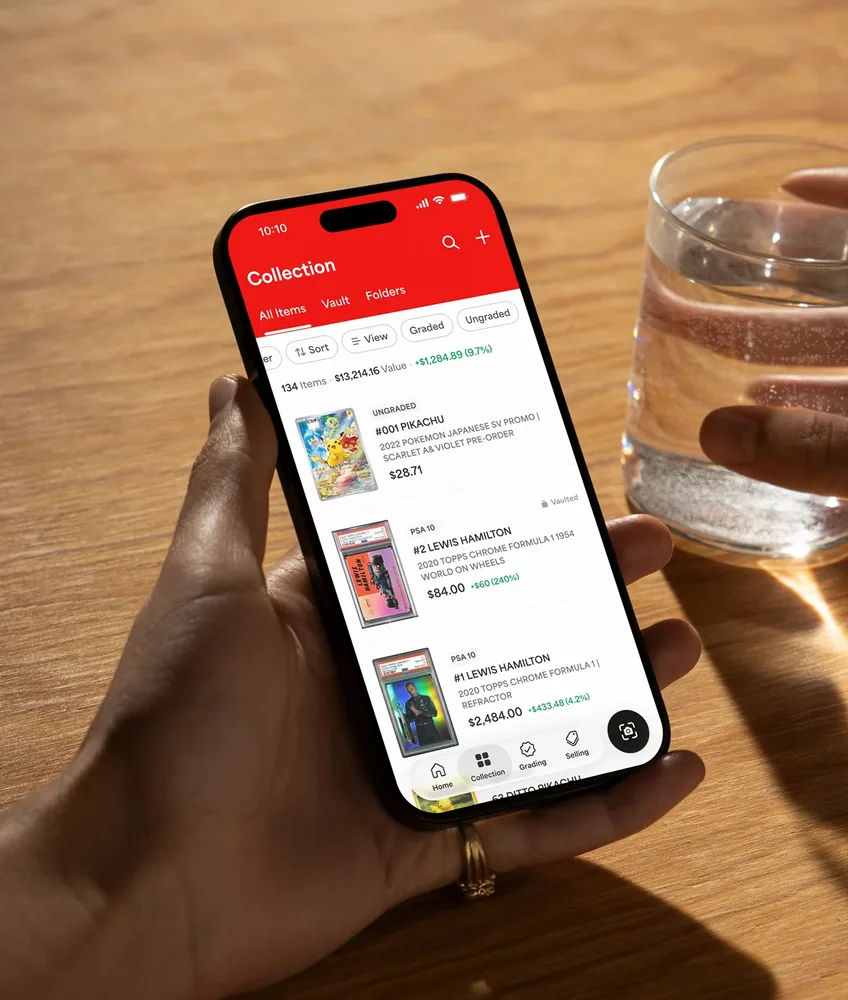 Image: PSA
The same app is a price tool: PSA's app page says "Scan to research, tap to submit, manage your collection, track your portfolio, consign to sell," and lists "price estimates" and "sales history" for cards you add. The cards on PSA's promotional screen are a Pokémon card and Formula 1 cards, not sports cards from our coverage; the screen layout is the point.
Analysis: grading at the show
PSA runs submission desks at some events. Its events page: "Submit your collectibles in person for grading, vaulting, and eBay consignment," and "Hand-deliver your collectibles directly to PSA employees." What it takes varies: "At select events, PSA may accept additional items or offer more services." PSA's FAQ says the online show schedule "lists the services we will be performing at each event," and warns that "if your item fails to pass our process, you will still be responsible for the charges."
PSA posts a list each month. Its October 2026 list, read on October 11, showed walk-in days at PSA Jersey City and PSA Santa Ana on October 14, plus New York Comic Con (October 8 to 11) and LA Galaxy Marvel Night (October 17). Those dates have passed: on October 21 the same page read "There are currently no upcoming events scheduled for October." The events page still links November and December schedules. Fees are the usual PSA tiers; our PSA grading fees guide lists them. On-site grading prices quoted by collectors online are not PSA figures, so check the event page.
Community: what collectors tell first-timers
An r/sportscards thread from March 2026, "Tips for card shows?", collected the advice in one place. u/pendcuse described a routine: "I like to just take a lap around look at the cards I wanna buy," then check comps, and "If a card is close to the comps then I think about buying it." u/mctennisd added: "Don't be afraid to walk away from a deal," and "Set a budget for the event and stick to it." (thread)
On timing, the same thread split. u/TechTOKE22: "Last day of the show, 30-45 minutes before close, gets yourself the best deals sometimes." On bringing cards to trade, u/StopHoardingCards warned: "If you bring any cards with you, make sure they are secure." These are individual opinions from one discussion, not rules.
Our take
Based on the show pages, PSA's tools and the collector advice cited above: the best card show habit is checking prices before paying, because a sticker is an opening ask and the collectors we quote treat negotiation as normal. Cash keeps that simple. Look up a slab's cert at the table, and treat on-site grading as a convenience with the usual fees, not a shortcut around them. We do not say what to buy; a show is a place to pay a fair price for cards you already wanted.
Frequently Asked Questions
The six questions above cover what to bring, cash, fair prices, grading at shows, checking slabs and timing.
What should I bring to my first card show?
Cash, a phone for price checks and a list of what you want. The National's FAQ lists 15 ATMs throughout the show, and parking there takes cash or credit. Collectors on r/sportscards add a budget, your comps written down, and a secure case for any cards you bring to trade.
Is cash better at a card show?
Cash is the safe default. A commenter in an r/sportscards thread of show tips wrote 'Cash is King' when talking about negotiating. The National's FAQ mentions cash or credit only for parking, so ask each dealer what they take, and know where the ATMs are before you start buying.
How do I know if a card show price is fair?
Check recent sales before you offer. PSA's card value page suggests searching Auction Prices Realized with the year, maker and player, and checking the number of bids as well as the final price. PSA says its Price Guide reflects average dealer selling prices for PSA-certified cards, so you may pay more than listed.
Can you get cards graded at a card show?
At some shows. PSA's events page says you can submit in person for grading, vaulting and eBay consignment and hand items to PSA employees, and PSA's FAQ says its show schedule lists the services at each event. PSA also says you are still charged if an item fails its process.
How do I check a graded card at a dealer's table?
Use the cert number. PSA lists Cert Verification among its research tools, and PSA's FAQ says its imaging of cards lets collectors verify an item's details, including its cert number, before buying. Compare the card in hand with PSA's record, not just the number.
When is the best time to buy at a card show?
Collectors split on it. In one r/sportscards thread, one commenter advised arriving as early as possible, while another said the last 30 to 45 minutes of the last day sometimes gets the best deals, because some vendors are more willing to sell cards that have not moved all show. Neither is a rule; it depends on the show.
How we checked this
The National Sports Collectors Convention's home page and FAQ were read on October 11, 2026; the 2026 National took place July 29 to August 2, so its prices and hours are past and shown as a template. PSA's events page, October 2026 event list, app page, FAQ, card value page and Price Guide page were read the same day, and the events page, October list and app page again on October 21. Collector comments come from r/sportscards comment feeds saved on October 11. We did not attend a show for this article. Full source table: data/sources/card-show-tips-for-beginners.sources.md.
References
- National Sports Collectors Convention, home and tickets: https://www.nsccshow.com/
- National Sports Collectors Convention, FAQ: https://www.nsccshow.com/faq
- PSA, events and drop-off: https://www.psacard.com/events
- PSA, where to find PSA in October 2026: https://www.psacard.com/articles/articleview/15647/where-to-find-psa-in-october-2026
- PSA, apps: https://www.psacard.com/info/apps
- PSA, FAQ: https://www.psacard.com/support/faq
- PSA, what are your trading cards worth: https://www.psacard.com/cardvalue
- PSA, Price Guide: https://www.psacard.com/priceguide
- Reddit r/sportscards, Tips for card shows?: https://www.reddit.com/r/sportscards/comments/1rk9j3l/tips_for_card_shows/
Related Reading
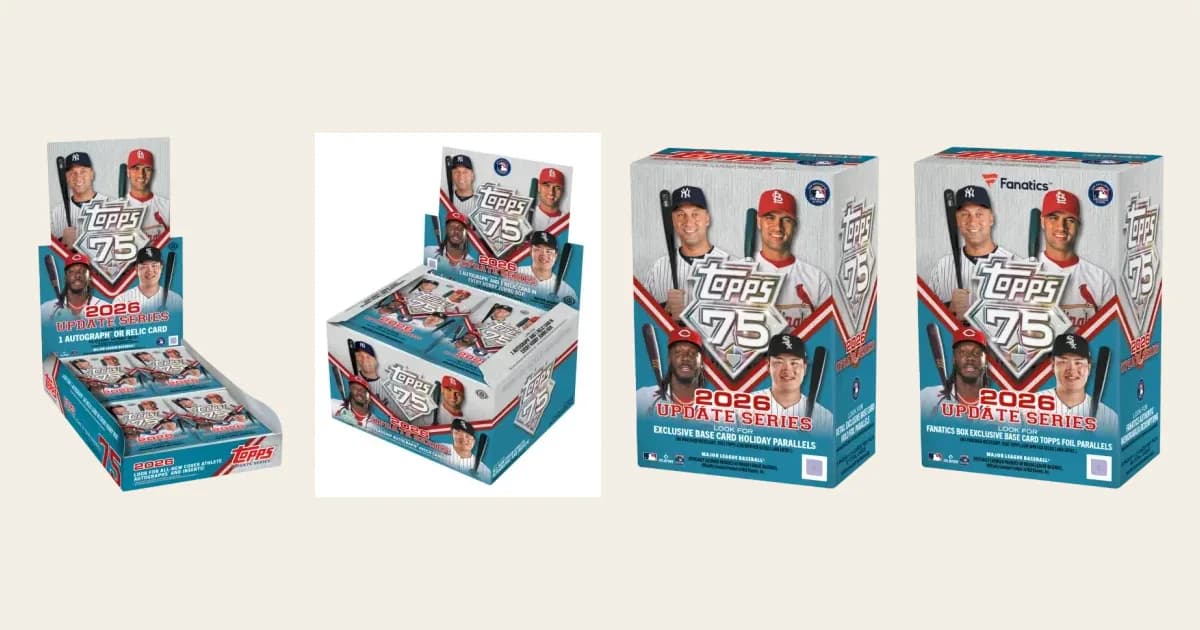
- How to Start Collecting Sports Cards: 2026 Beginner Guide: card types and box formats to know before you walk the floor.
- eBay Authenticity Guarantee for Sports Cards: How It Works: the online alternative when you want a third party to check a card.
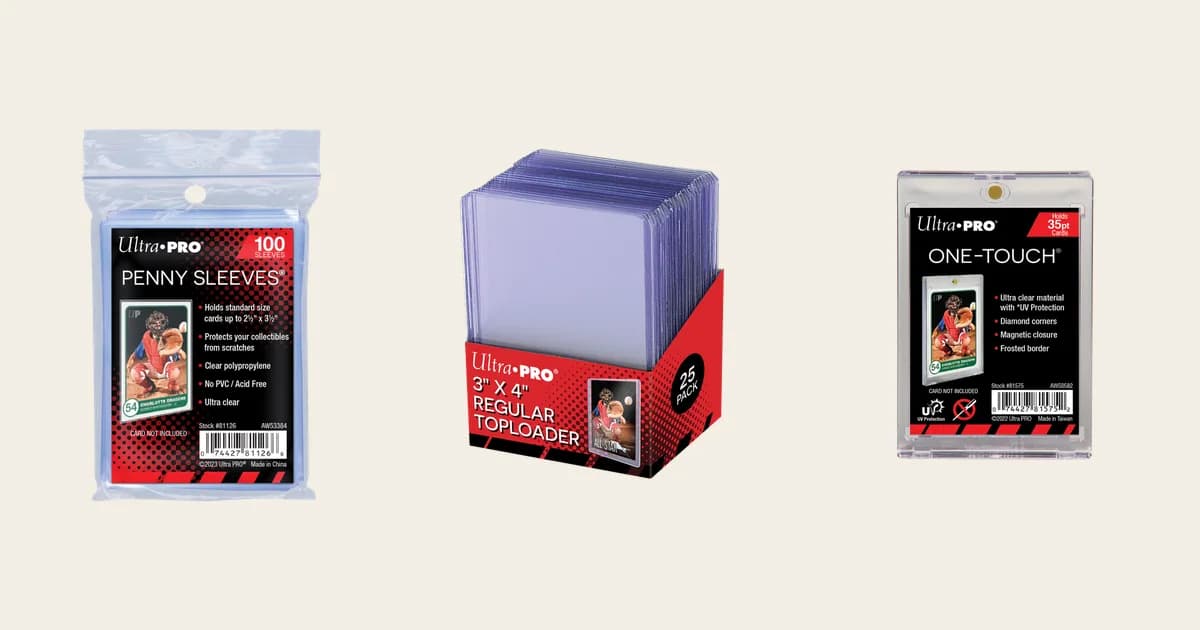
- How to Store Sports Cards: Sleeves, Toploaders and Humidity: what to put your new cards in on the way home.
About the author

Editorial desk
The RookieDesk desk. We read the paperwork before you open the box: Topps' checklists and odds sheets, the box art, grader fee pages. Every number links to its source and carries the date we checked it.
Keep reading
How to Display Graded Cards: Stands, Binders and UV Light
Guides · 8 min
How to Sell Sports Cards on eBay: Fees, Photos and Shipping
Guides · 10 min
How to Ship Sports Cards: Letter, eBay Envelope or Tracked
Guides · 10 min
How to Spot Fake Sports Cards and Fake PSA Slabs in 2026
Guides · 9 min
eBay Authenticity Guarantee for Sports Cards: How It Works
Guides · 8 min
How to Store Sports Cards: Sleeves, Toploaders and Humidity
Guides · 9 min
How to Read Sports Card Odds: Topps Odds Sheets Explained
Guides · 11 min

What Is a Case Hit? Sports Card Case Hits Explained
Guides · 8 min
Disclaimer
RookieDesk publishes data, not investment or financial advice. Odds are the manufacturer's published odds, not a promise of what any one box contains. Checklists, release dates, grading fees and prices change after publication; each one here carries the date we checked it. Confirm critical details with the manufacturer, grader or seller before you buy or submit. RookieDesk is independent and not affiliated with any card manufacturer, league or players association, and carries no affiliate links, ads or sponsored posts; see our independence note. Articles are researched and written with AI tools, and every fact is checked against its cited source before publishing; see how we use AI.