Guides
What Is a Refractor Card? Refractors and SuperFractors
What is a refractor card? Topps, CGC and PSA definitions, how refractors began in 1993 Finest, and a real refractor ladder from Topps' Cosmic Chrome odds.
TL;DR: Topps says refractor cards "utilize a special printing technology to create a unique visual effect," and "Each color is printed to a different quantity." CGC calls it "a prism or rainbow-like effect." PSA dates chromium cards to 1993 Topps Finest, with refractors two per box. On 2026 Cosmic Chrome, a plain Refractor is 1:10 in hobby and the 1-of-1 SuperFractor is 1:7,567.
6 min readBy RookieDesk Editorial
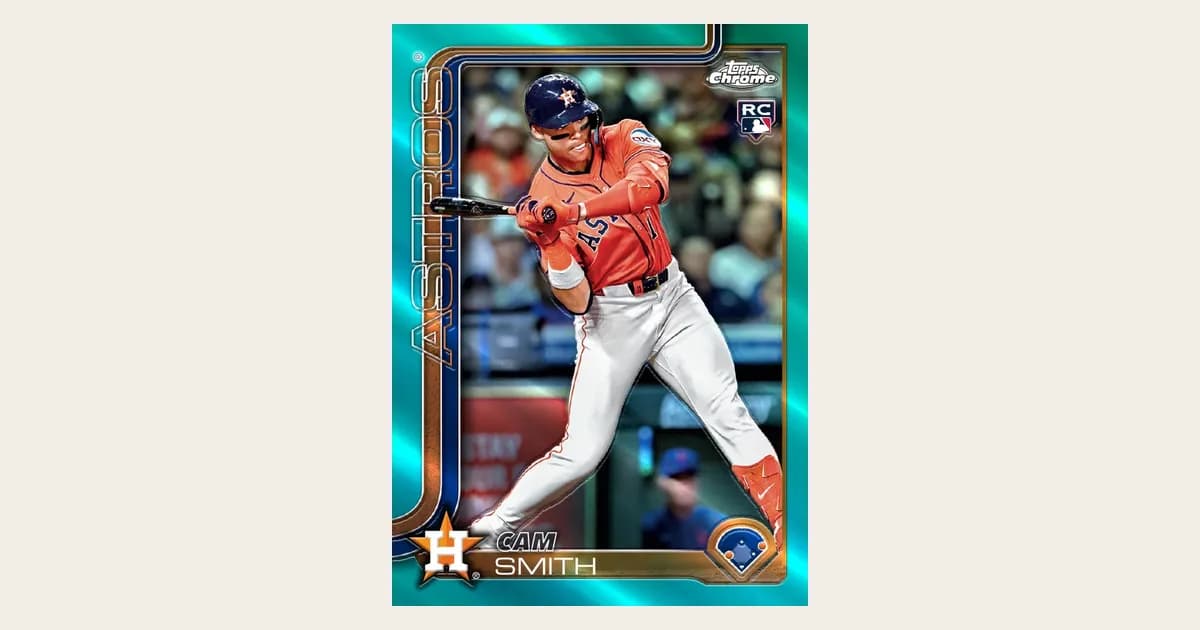
What is a refractor card? It is a chromium parallel printed so that it bends light into a rainbow-like shine, and Topps prints each refractor color to a different quantity, up to the one-of-one SuperFractor. This guide uses Topps', CGC's and PSA's own definitions, the 1993 set that started it, and a real refractor ladder from a 2026 Topps odds sheet.
What Is a Refractor Card? (quick answer)
A refractor is a type of parallel: the same card as the base version, printed with a different finish. Topps' Ripped glossary says "Refractor Cards utilize a special printing technology to create a unique visual effect." CGC's glossary describes a printing technology that "refracts and disperses light in a manner that creates a prism or rainbow-like effect, similar to a Panini Prizm card," and adds: "Topps was the first trading card company to utilize this printing process."
Key Takeaways
- Definition: a chromium parallel with a light-bending, rainbow-like finish (Topps, CGC).
- Colors: Topps prints each refractor color "to a different quantity," and they "tend to be numbered."
- SuperFractor: a 1-of-1 by Topps' definition, the top of the ladder.
- Origin: 1993 Topps Finest Baseball, refractors two per box (PSA CardFacts).
- Rarity: read the odds sheet; on 2026 Cosmic Chrome the ladder runs from 1:10 to 1:7,567.
- Care: PSA says removing the thin protective film costs some value.
Refractor, chrome and parallel: how the terms fit
The words get mixed up, so here is how the official glossaries separate them. Chrome is the card stock: CGC defines it as "the metallic-like card stock manufactured by Topps." A parallel is any version of a base card that differs in one way; Topps lists "border color, texture, pattern, card material, image variation, or the printing technology employed," and Upper Deck says a parallel "typically has the same design and photo as a base card but offers a different, higher-end color scheme with limited copies." A refractor is a chrome parallel made with that light-bending printing.
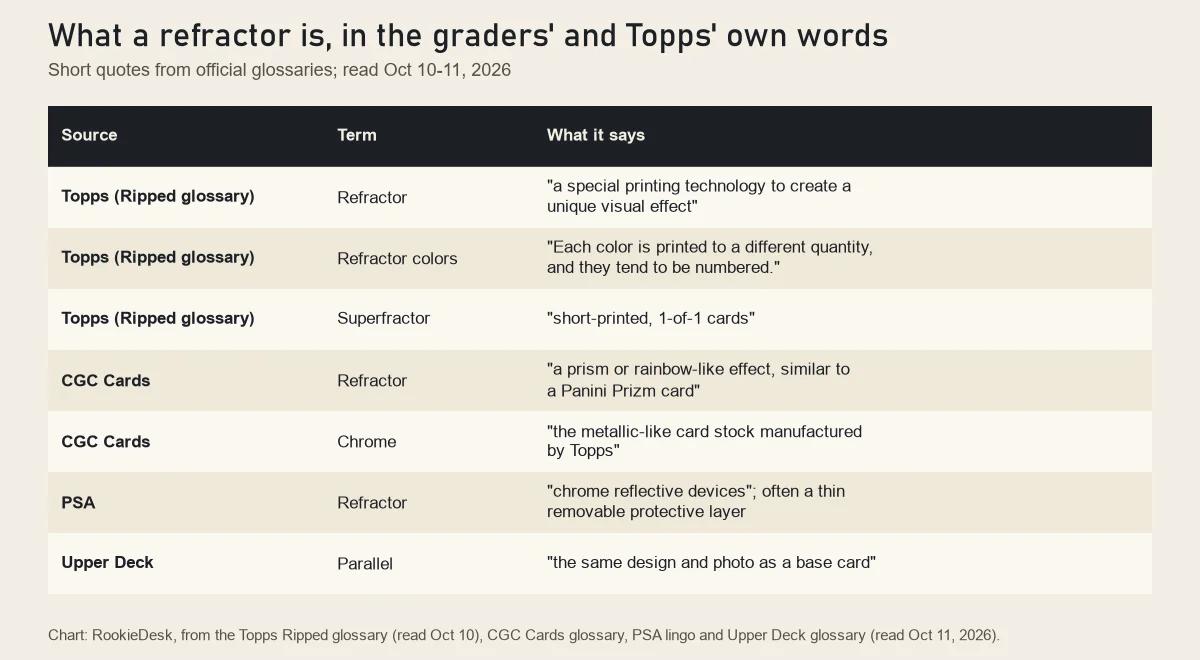 Chart: RookieDesk, from the Topps Ripped glossary (read October 10, 2026), CGC Cards glossary, PSA lingo and Upper Deck glossary (read October 11, 2026)
Refractor vs Prizm. Panini makes a similar card under its own name. CGC defines Prizm as "a term used by Panini America to describe their own type of specific parallel cards" with "a metallic-like finish that is similar to the Topps product called Chrome."
PSA's angle. PSA's lingo page describes a refractor as "A card that has chrome reflective devices," and warns: "These cards often come with a thin removable protective layer. The card loses some value if this plastic layer is removed."
Where refractors came from: 1993 Topps Finest
PSA's CardFacts profile of 1993 Topps Finest Baseball says "it was the first series to use chromium technology on cards." It adds that "The Refractor parallel cards were issued two-per-box, and are the cards that drive contemporary interest in the set," and that "The introduction of Refractor cards also spawned the idea of a parallel rainbow that is so much a part of the hobby today."
Cardlines, a secondary source, notes the first ones "wasn't even labeled as such and distinguished from the normal chrome cards at the time." Over the years Topps added "X-Fractors, Superfractors, and Atomic Refractors," in Cardlines' words. We found no official glossary entry for X-Fractor at PSA, CGC or Upper Deck, so we do not define it here.
The refractor ladder: a real example from 2026 Cosmic Chrome
Topps says "Each color is printed to a different quantity," and the odds sheet shows what that looks like. For 2026 Topps Cosmic Chrome Baseball, the base card has 13 refractor tiers in the hobby column.
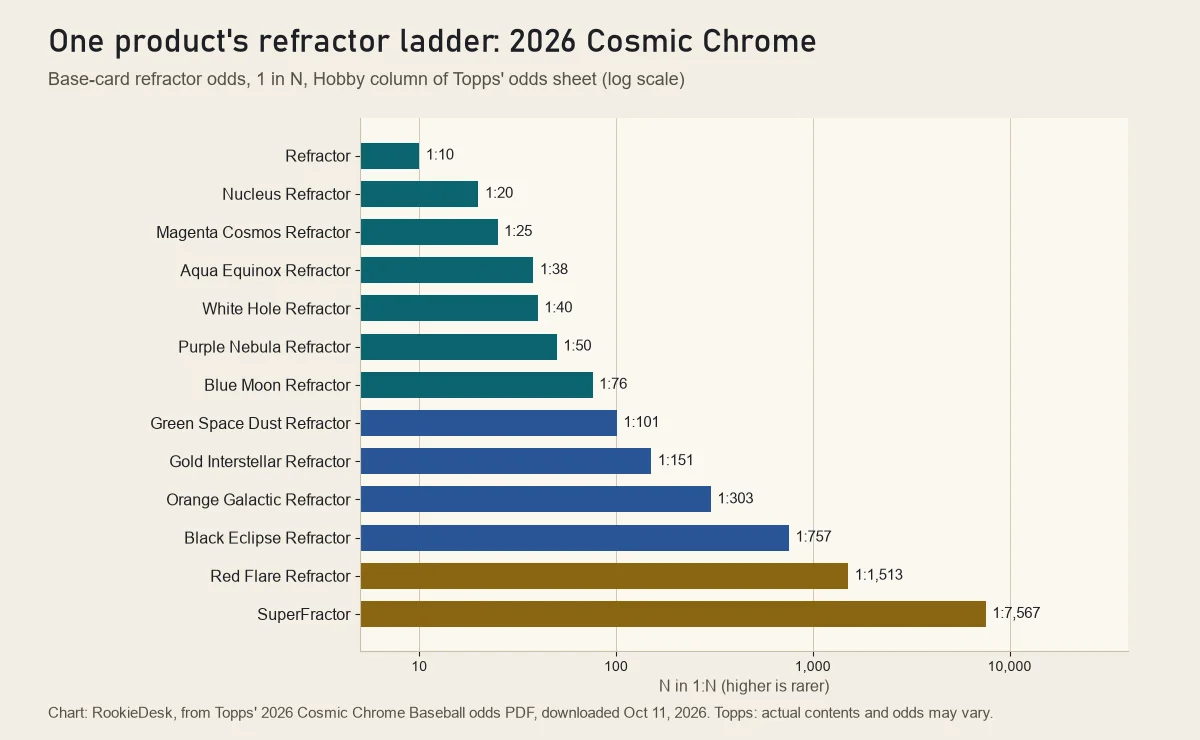 Chart: RookieDesk, from Topps' 2026 Cosmic Chrome Baseball odds PDF (downloaded October 11, 2026)
The plain Refractor is 1:10, the Gold Interstellar 1:151, the Black Eclipse 1:757 and the SuperFractor 1:7,567, about 757 times rarer than the plain Refractor on the same sheet. A second format adds its own color: the Lunar Eclipse Refractor appears only in the Lunar column, at 1:2. Inserts can have their own ladder too; the Starfractor insert runs from Orange (1:605) to Pink (1:15,251).
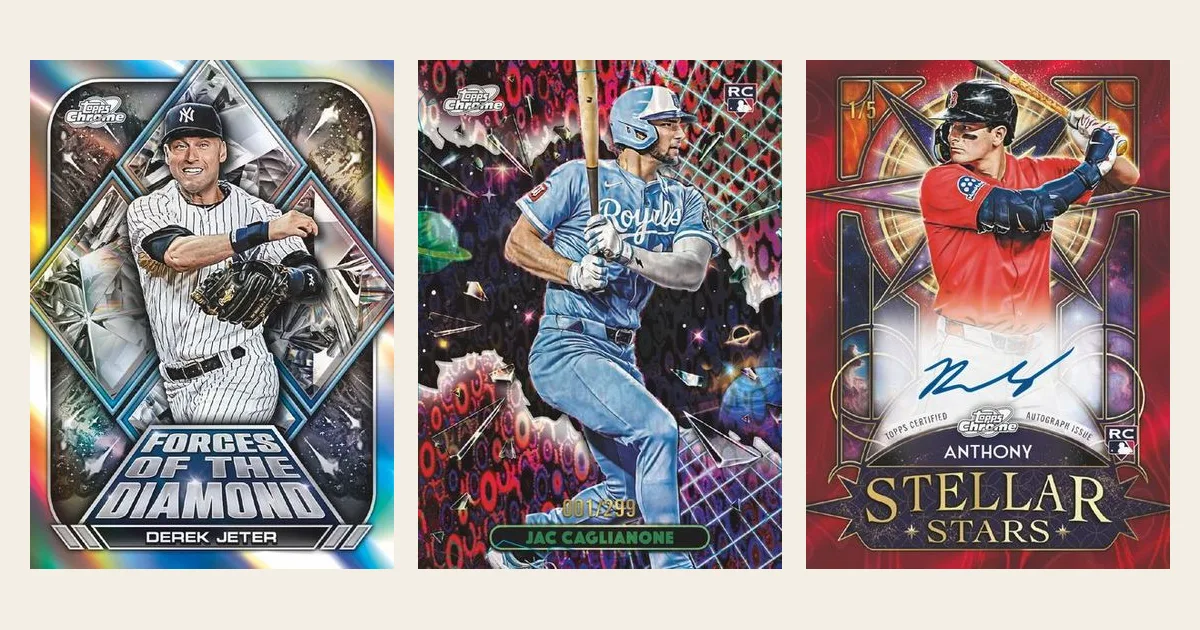 Card images: Topps (Topps product page), lined up by RookieDesk
Two limits. The Topps sheet gives odds, not print runs, and it does not say whether 1:10 is per pack or per box; our guide to reading sports card odds explains the format. The sheet prints no serial numbers either; Checklist Insider, a secondary site, lists the Magenta Cosmos Refractor as "/299." Every refractor tier on the sheet is listed on our Cosmic Chrome parallels page.
GODEEPER: The full Cosmic Chrome odds sheet, hobby and Lunar side by side, with Planetary Pursuit from Sun to Pluto. 2026 Topps Cosmic Chrome Baseball Odds and Parallels Guide →
SuperFractor: the top of the ladder
Topps' definition is short: "Superfractors are short-printed, 1-of-1 cards, which means that for any given card, there will be only one superfractor of that card in the entire product." That makes it a special case of a short print. On the 2026 Cosmic Chrome sheet the base SuperFractor is 1:7,567 in hobby, and an insert SuperFractor can be far rarer, such as 1:366,040 for Triple Star Clusters.
Telling a refractor from a base card
This is the question collectors actually ask. In August 2026, u/clmarti02 wrote on r/footballcards: "Sellers are describing cards as Refractor parallel, but they sure do look like base. Both are un-numbered, so is there an ‘easy’ way to tell the difference?" (post) A returning collector, u/FootballJeepGuy, admitted in July that he "didn’t realize for a couple months that there was a difference between base cards and Prizm Silver/Chrome Refractor." (post) Both are personal posts.
I’m working on a base set of the new Resurgence. So, buying a lot of singles on ebay. Sellers are describing cards as Refractor parallel, but they sure do look like base. Both are un-numbered, so is there an ‘easy’ way to tell the difference? Or, maybe, how to identify the refractor version? TIA!
What the sources give you to check: the finish (the rainbow effect CGC describes), a serial number if the color is numbered (Topps says they "tend to be"), and the product's own parallel list on the checklist or odds sheet. For an expensive card, our guide to spotting fake sports cards covers PSA and CGC holder and label checks.
Our take
"Refractor" names the finish, not the rarity: read the color and the odds sheet. A plain 2026 Cosmic Chrome Refractor at 1:10 and a SuperFractor at 1:7,567 are both refractors. The color name, the serial number if there is one, and the manufacturer's odds sheet are what separate them. And if your card still has its film, PSA's glossary is clear that peeling it costs value.
Frequently Asked Questions
The six questions below cover the definition, rarity, SuperFractors, the first refractor, refractor vs Prizm and the protective film.
What is a refractor card?
A refractor is a chromium card printed with a technology that gives it a light-bending, rainbow-like shine. Topps says refractor cards use a special printing technology to create a unique visual effect; CGC describes a prism or rainbow-like effect similar to a Panini Prizm card.
Is a refractor rare?
It depends on the color. On Topps' 2026 Cosmic Chrome Baseball odds sheet, the plain Refractor is 1:10 in hobby while the SuperFractor is 1:7,567. Topps says each refractor color is printed to a different quantity.
What is a SuperFractor?
Topps defines superfractors as short-printed, 1-of-1 cards: for any given card there is only one superfractor of it in the whole product.
When did refractor cards start?
PSA's CardFacts page says 1993 Topps Finest Baseball was the first series to use chromium technology, with refractor parallels issued two per box. Cardlines adds that those first refractors were not labelled as such.
Is a refractor the same as a Prizm?
They are similar effects from different companies. CGC's glossary compares the refractor effect to a Panini Prizm card and describes Prizm as Panini's own type of parallel, with a metallic-like finish similar to Topps Chrome.
Should I peel the film off a refractor?
PSA's glossary says refractors often come with a thin removable protective layer and that the card loses some value if this plastic layer is removed.
How we checked this
Definitions come from the CGC Cards glossary, PSA's lingo page and Upper Deck's glossary, read on October 11, 2026, and from Topps' Ripped glossary, read on October 10. The 1993 history comes from PSA's CardFacts page (read October 11), with Cardlines as a secondary source. Odds come only from Topps' 2026 Cosmic Chrome Baseball odds PDF, downloaded October 11. It matched byte for byte on October 24. The Reddit posts were re-read through the Arctic Shift archive on October 24 and are personal views. We found no official X-Fractor definition and no official video on refractors.
References
- Topps Ripped glossary, Refractor: https://ripped.topps.com/definition/refractor/
- Topps Ripped glossary, Superfractor: https://ripped.topps.com/definition/superfractor/
- CGC Cards glossary: https://www.cgccards.com/glossary/
- PSA lingo, R: https://www.psacard.com/resources/lingo/r
- PSA CardFacts, 1993 Topps Finest Baseball: https://www.psacard.com/cardfacts/baseball-cards/1993-finest/33357
- Topps 2026 Cosmic Chrome Baseball odds (PDF): https://cdn.shopify.com/s/files/1/0662/9749/5709/files/2026-09-28_2026-Topps-Cosmic-Chrome-Baseball_Odds.pdf?v=1790610132
- Cardlines, Topps Chrome Superfractor (secondary): https://cardlines.com/topps-chrome-superfractor-card
Related Reading
- How to Start Collecting Sports Cards: 2026 Beginner Guide: the beginner pillar, from packs to grading.
- 2026 Topps Cosmic Chrome Checklist: Rookies, Autos, Inserts: who is on the checklist behind these refractors.
- What Is a Relic Card? Jersey, Patch and Bat Cards Explained: the other big category of chase card.
- 2026 Topps Finest Baseball Odds: Hobby Auto 1:11, Mega 1:657: the Finest refractor ladder, with Topps' odds in four box columns.
About the author

Editorial desk
The RookieDesk desk. We read the paperwork before you open the box: Topps' checklists and odds sheets, the box art, grader fee pages. Every number links to its source and carries the date we checked it.
Keep reading
What Is a Hit Card? Update's Odds Add Up to 1.06 a Box
Guides · 7 min
What Is a Redemption Card? 34 Real 1976 Paytons in 2026
Guides · 6 min
What Is a Relic Card? Jersey, Patch and Bat Cards Explained
Guides · 7 min
What Is a Base Card? 60 Look-Alikes on One 2026 Odds Sheet
Guides · 7 min
What Is an RPA Card? Rookie Patch Auto, With 2026 Examples
Guides · 10 min
On-Card vs Sticker Autographs: 3,200 Lines, None Labelled
Guides · 6 min
What Is an Insert Card? About 11 per Cosmic Chrome Hobby Box
Guides · 6 min
What Is a Rip Card? Allen & Ginter Rip Cards and Odds
Guides · 7 min
Disclaimer
RookieDesk publishes data, not investment or financial advice. Odds are the manufacturer's published odds, not a promise of what any one box contains. Checklists, release dates, grading fees and prices change after publication; each one here carries the date we checked it. Confirm critical details with the manufacturer, grader or seller before you buy or submit. RookieDesk is independent and not affiliated with any card manufacturer, league or players association, and carries no affiliate links, ads or sponsored posts; see our independence note. Articles are researched and written with AI tools, and every fact is checked against its cited source before publishing; see how we use AI.