Guides
What Is a Printing Plate Card? 1/1 Plates and 2026 Odds
A printing plate card is a real plate used to print a card, in cyan, magenta, yellow or black, each one of a kind. Topps' 2026 plate odds by box format.
TL;DR: A printing plate card is one of the four plates (black, cyan, magenta, yellow) used to print a card, cut to card size and inserted into packs. Each is a 1/1. On 2026 Topps sheets, Update Series base plates run 1:10,717 in hobby and 1:2,582 in jumbo, Allen & Ginter framed mini plates 1:6,785 in hobby, and Museum Collection base plates 1:114.
7 min readBy RookieDesk Editorial
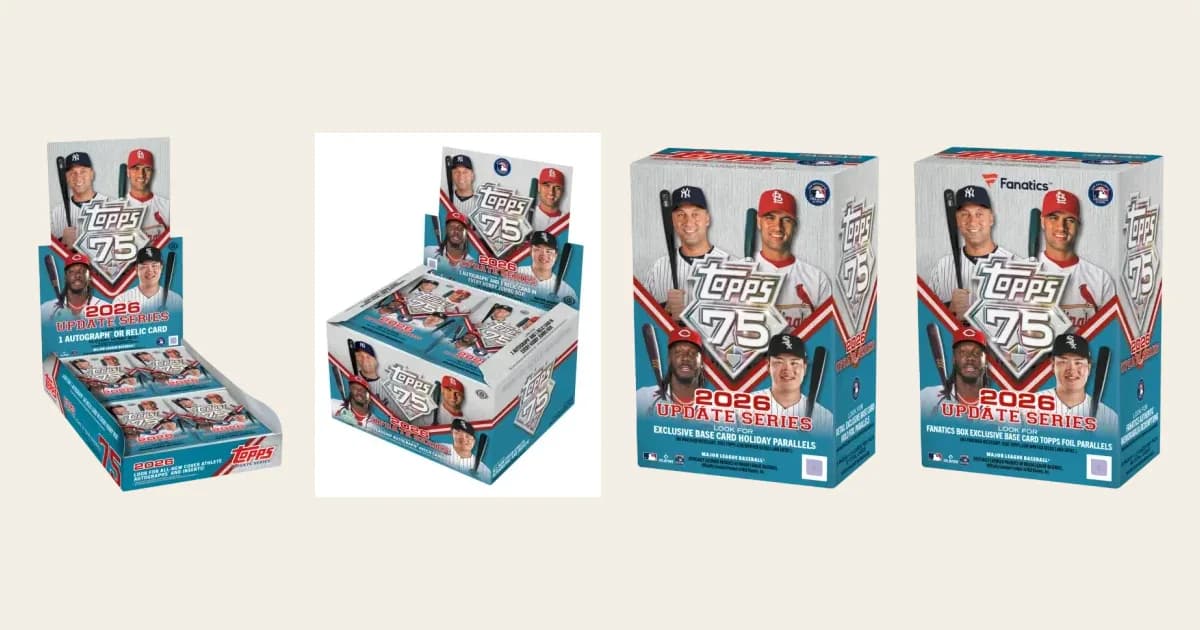
A printing plate card is the actual plate a manufacturer used to print a card, cut down to card size and put into a pack. Each card is printed from four of them, one per ink color, and every plate is one of a kind. Below is what the plates are, and what Topps' 2026 odds sheets say about finding one, checked on October 12, 2026.
What is a printing plate card? (quick answer)
A printing plate card is a piece of the printing process sold as a card. CGC's glossary describes printing plates as "the plates used in the printing process that have been cut to standard card size and placed randomly into packs as an Insert." Upper Deck's glossary calls them "one-of-a-kind," which is why collectors treat each plate as a 1/1.
Key Takeaways
- What it is: a real printing plate, cut to card size and seeded in packs.
- Four per card: black, cyan, magenta and yellow, per CGC and Upper Deck.
- One of a kind: Upper Deck's glossary calls them "one-of-a-kind."
- Update Series: base plates 1:10,717 hobby, 1:2,582 jumbo, 1:17,384 value box.
- Allen & Ginter: framed mini plates 1:6,785 hobby, and one of the "any 2" hobby hits.
- Museum Collection: base plates 1:114, the shortest ratio of the three sheets.
Overview: what the plate on a printing plate card is
A card is printed from four plates, one per ink. CGC puts it this way: "A card is printed using four (4) individual plates in the following colors: Black, Cyan, Magenta and Yellow." Upper Deck's glossary agrees and adds the collecting point: "A special plate used to print trading cards. These "cards" are one-of-a-kind and come in four printing colors: black, cyan, magenta, and yellow."
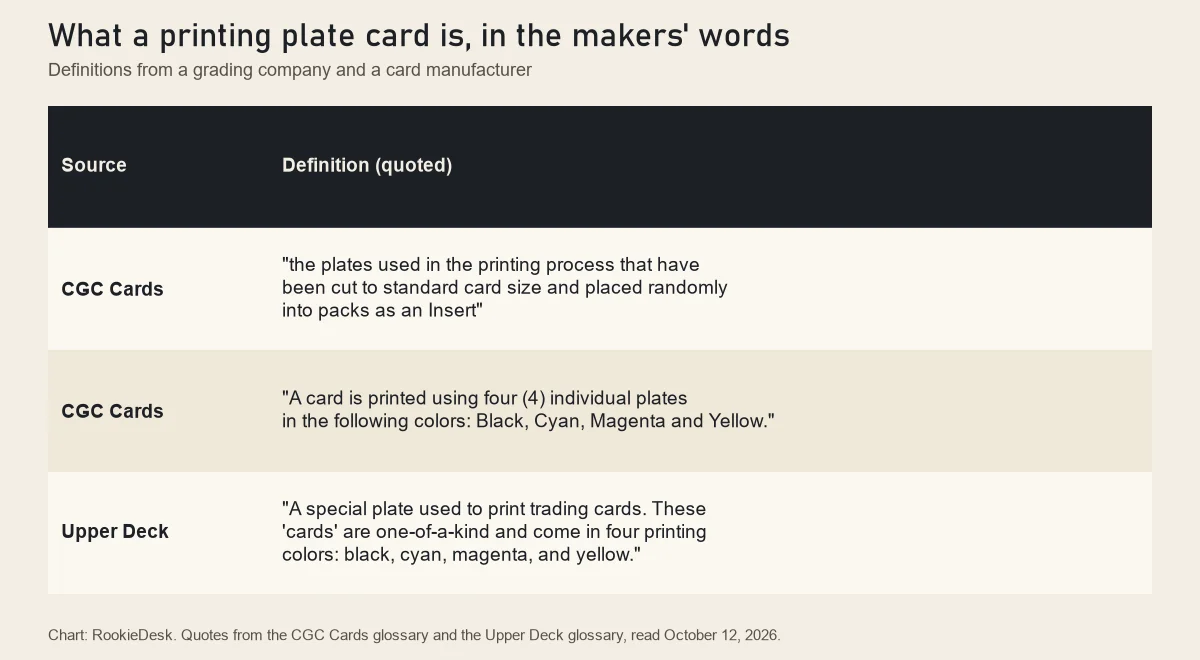 Chart: RookieDesk, quotes from the CGC Cards and Upper Deck glossaries (read October 12, 2026)
So one base card can, in principle, yield four plate cards: a black, a cyan, a magenta and a yellow. Collectors chasing every version of one card, a "rainbow," count plates in. u/nolsklirt's post "2026 Topps Chrome Luis Castillo Rainbow" on r/baseballcards lists "1/1 Printing Plate" among the cards still missing, next to the Superfractor.
Plates sit in the same family as other 1/1 cards. Our guide to numbered cards covers what /99, /25 and 1/1 mean, and the refractor guide covers the Superfractor, the Chrome world's 1/1.
Analysis: printing plate card odds in 2026 Update Series
Topps' 2026 Update Series odds sheet has one plate row, "BASE CARDS PRINTING PLATES," and a ratio for all nine box formats. Jumbo is the shortest at 1:2,582 and Japan Exclusive the longest at 1:18,085.
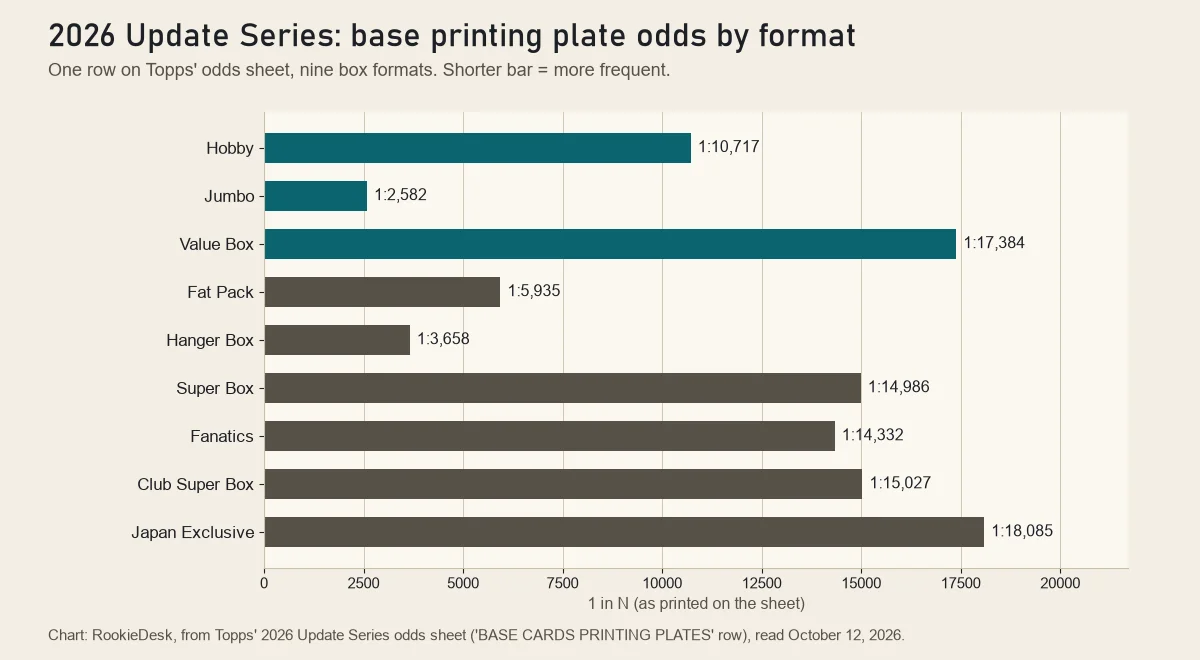 Chart: RookieDesk, from Topps' 2026 Update Series odds sheet (read October 12, 2026)
Topps does not print the unit, but its ratios read as per pack, as our guide to reading sports card odds explains. Topps' box guide lists the hobby box as "Twenty-one packs per box," the jumbo as "Twelve packs per box" and the value box as "Six packs per box." Read per pack, that works out to about one plate per 510 hobby boxes, 215 jumbo boxes or 2,897 value boxes, on average. Jumbo packs also hold forty cards each, against twelve in hobby, so the per-pack ratios are not like for like.
These are averages across the whole print run, not a promise for any box. The chance-to-pull calculator shows the same math for any number of boxes. Our 2026 Topps Update Series checklist and odds guide has the rest of that sheet.
GODEEPER: Why each box format gets its own column, and how hobby, jumbo and value boxes differ. Sports Card Boxes Explained: Hobby vs Jumbo vs Blaster →
Analysis: plates on the Allen & Ginter and Museum Collection sheets
Not every Topps sheet treats plates the same way. Here are the plate rows on three 2026 sheets, as printed:
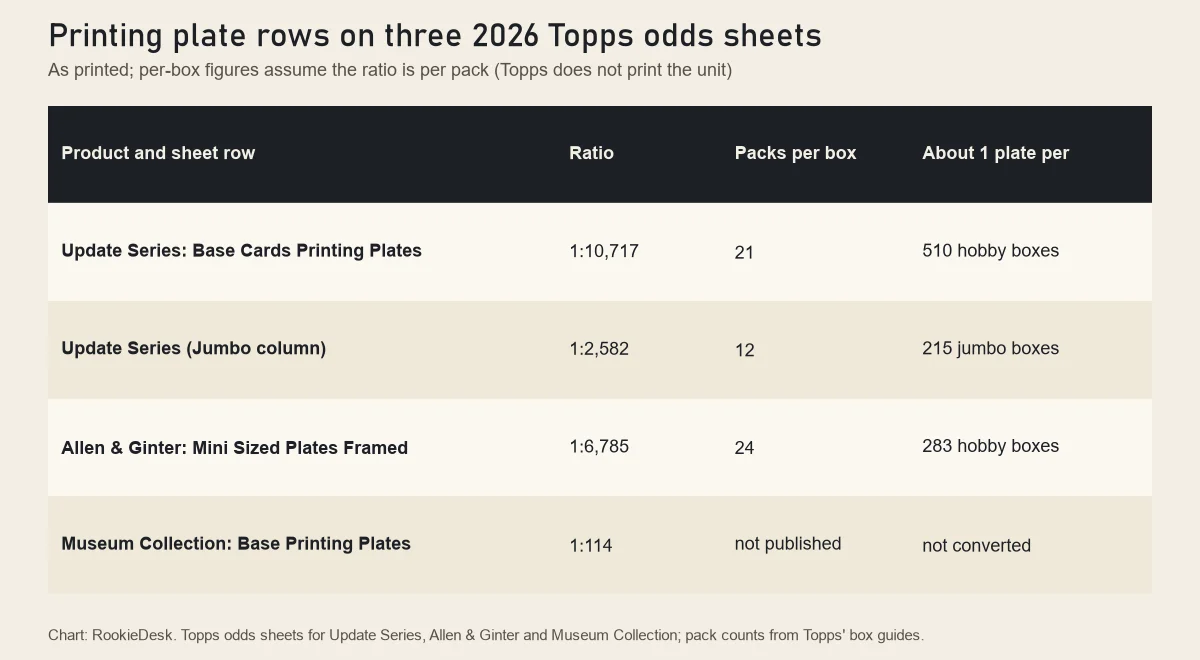 Chart: RookieDesk, from Topps' 2026 Update Series, Allen & Ginter and Museum Collection odds sheets; pack counts from Topps' box guides
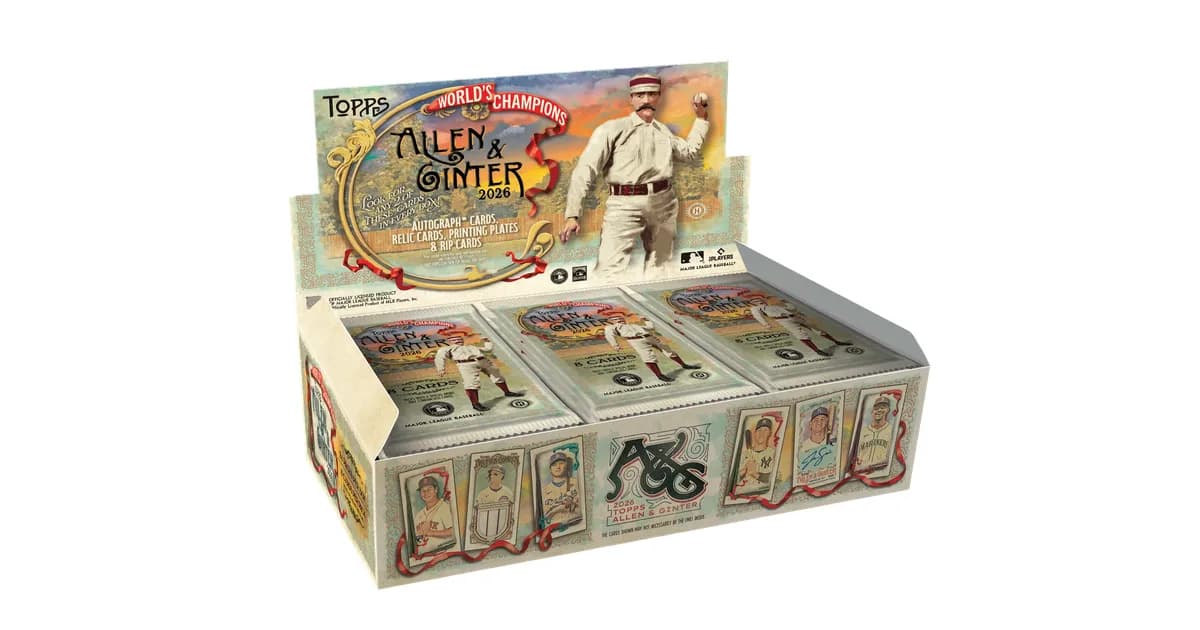
Allen & Ginter. The plate row is "BASE CARD MINI SIZED PRINTING PLATES FRAMED": 1:3,847 in fat packs, 1:6,785 in hobby and 1:9,047 in value boxes. In this set a plate is also one of the box's promised hits. The 2026 hobby box lid says "LOOK FOR ANY 2 OF THESE CARDS IN EVERY BOX!" over "AUTOGRAPH* CARDS, RELIC CARDS, PRINTING PLATES & RIP CARDS." Topps' box guide and the box itself say 24 packs per hobby box (DK Network and Cardlines listed 18 during preorders). With 24, the per-pack reading gives about one framed plate per 283 hobby boxes. Our Allen & Ginter checklist and odds guide lists every row.
Museum Collection. The sheet's single Hobby column reads "Base Printing Plates 1:114." That is far shorter than the other two, but the sheet does not say whether 1:114 counts packs or boxes, and Topps' product page listed no pack count when it was read on October 11. We leave it unconverted. Our 2026 Museum Collection checklist covers the set.
Cosmic Chrome. Its 2026 odds sheet has no printing plate row at all.
GODEEPER: Allen & Ginter's other hobby-only hit, the card you tear open to find a mini inside. What Is a Rip Card? Allen & Ginter Rip Cards and Odds →
Community: what collectors report
The 2026 Allen & Ginter framed plates have already turned up. u/Sam_Kablam posted on October 11: "I ended up pulling this print plate for Xzibit! Problem is, the print plate rattles around within the card frame." (post) Topps' row name for these ends in "PRINTING PLATES FRAMED."
First time seeing A&G cards in the wild after learning I can pull cards like a dang PBJ sandwich. I ended up pulling this print plate for Xzibit! Problem is, the print plate rattles around within the card frame. Not sure if this is something I can get fixed, or if this expected when trying to sandwich a metal sheet between a plastic frame. Still pretty cool!
Plates are not new to Allen & Ginter. A September 19 post by u/thedaddystuff1979 about a 2014 Allen & Ginter plate reads: "Black, Cyan, Magenta, or Yellow Framed Mini Printing Plates inserted 1:412 packs. Serial numbered 1/1." (post) Both are personal posts.
Our take
Based on CGC's and Upper Deck's definitions and Topps' 2026 odds sheets: a printing plate card is a genuine 1/1, but a different kind of 1/1 from a Superfractor, because it is one of the plates that printed the card rather than a finished card. How often you see one depends heavily on the product and the box format. Update Series spreads plates across nine formats from 1:2,582 to 1:18,085, Allen & Ginter makes them one of its hobby hits, and Cosmic Chrome's sheet has no plate row at all. This is a reading of Topps' sheets, not a view on what any plate is worth.
Frequently Asked Questions
The six questions below cover what a plate is, how many exist per card, the 2026 Update Series and Allen & Ginter odds, whether a plate is a 1/1, and which sheet has the shortest ratio.
What is a printing plate card?
It is one of the metal plates used to print a card, cut to card size and inserted into packs. CGC's glossary says a card is printed with four plates, black, cyan, magenta and yellow. Upper Deck's glossary calls these cards one-of-a-kind, so each plate is a 1/1.
How many printing plates are there for one card?
Four, one for each printing color. CGC lists them as black, cyan, magenta and yellow, and Upper Deck names the same four colors. Each plate is unique, so a player's base card can have up to four plate 1/1s. Topps' checklists do not list plates player by player.
What are the odds of a printing plate in 2026 Topps Update Series?
Topps' odds sheet lists base card printing plates at 1:10,717 in hobby, 1:2,582 in jumbo and 1:17,384 in the value box, with six more formats between 1:3,658 and 1:18,085. Read per pack, that is about one plate per 510 hobby boxes or 215 jumbo boxes.
Are printing plates a hit in Allen & Ginter?
Yes. The 2026 Allen & Ginter hobby box says to look for any 2 autograph cards, relic cards, printing plates and Rip Cards in every box. Topps' odds sheet lists framed mini printing plates at 1:3,847 in fat packs, 1:6,785 in hobby and 1:9,047 in value boxes.
Is a printing plate a 1/1?
Yes. Upper Deck's glossary says printing plate cards are one-of-a-kind and come in four printing colors. On Reddit, collectors list plates as 1/1s, for example a 2016 Topps Bunt Ryne Sandberg Cyan Printing Plate 1/1. Up to four plates can exist for the same card, one per color, per CGC.
Which 2026 Topps sheet has the best printing plate odds?
Of the three 2026 sheets we compared, Museum Collection prints the shortest ratio, 1:114 for base printing plates in its single Hobby column. Topps does not say whether that is per pack or per box, and Museum has no published pack count, so the ratio cannot be compared directly with Update Series.
How we checked this
Definitions come from the CGC Cards glossary and the Upper Deck glossary, read October 12, 2026. Odds come from Topps' 2026 odds sheets for Update Series, Allen & Ginter, Museum Collection and Cosmic Chrome, downloaded from Topps' CDN and read as PDF text; every ratio is copied as printed. Pack counts come from Topps' box guides (read October 10). The per-box figures are our arithmetic, packs per box divided by the per-pack ratio, and assume Topps' ratios are per pack. Reddit posts were read through the subreddit's RSS feed on October 12 and are personal views. We have not opened these products.
References
- CGC Cards glossary: https://www.cgccards.com/glossary/
- Upper Deck glossary: https://upperdeck.com/guide-to-collecting/glossary-trading-cards-explained/
- Topps odds sheet, 2026 Update Series (PDF): https://cdn.shopify.com/s/files/1/0662/9749/5709/files/2026_Topps_Baseball_Updates_Series_Odds.pdf?v=1790610141
- Topps odds sheet, 2026 Allen & Ginter (PDF): https://cdn.shopify.com/s/files/1/0662/9749/5709/files/2026-09-29_MLB-ALLEN-_-GINTER-2026_Odds.pdf?v=1790697457
- Topps odds sheet, 2026 Museum Collection (PDF): https://cdn.shopify.com/s/files/1/0662/9749/5709/files/2026_Topps_Museum_Baseball_Odds.pdf?v=1789484095
- Topps Ripped, 2026 Update Series box guide: https://ripped.topps.com/2026-topps-update-series-baseball-box-guide/
- Reddit r/baseballcards, 2026 A&G Xzibit print plate: https://www.reddit.com/r/baseballcards/comments/1x2y27k/pulled_an_allen_ginter_xzibit_print_plate_card/
Related Reading
- How to Start Collecting Sports Cards: 2026 Beginner Guide: where plates fit among inserts, parallels and hits.
- What Is a Case Hit? Sports Card Case Hits Explained: another way Topps describes how rare a card is.
About the author

Editorial desk
The RookieDesk desk. We read the paperwork before you open the box: Topps' checklists and odds sheets, the box art, grader fee pages. Every number links to its source and carries the date we checked it.
Keep reading
What Is a Rip Card? Allen & Ginter Rip Cards and Odds
Guides · 7 min
What Is an RPA Card? Rookie Patch Auto, With 2026 Examples
Guides · 10 min
What Is a Mega Box? Topps' Retail Box, 42 to 180 Cards
Guides · 10 min
What Is a Hit Card? Update's Odds Add Up to 1.06 a Box
Guides · 7 min
What Is a Refractor Card? Refractors and SuperFractors
Guides · 6 min
What Is a Redemption Card? 34 Real 1976 Paytons in 2026
Guides · 6 min
What Is a Relic Card? Jersey, Patch and Bat Cards Explained
Guides · 7 min
What Is a Base Card? 60 Look-Alikes on One 2026 Odds Sheet
Guides · 7 min
Disclaimer
RookieDesk publishes data, not investment or financial advice. Odds are the manufacturer's published odds, not a promise of what any one box contains. Checklists, release dates, grading fees and prices change after publication; each one here carries the date we checked it. Confirm critical details with the manufacturer, grader or seller before you buy or submit. RookieDesk is independent and not affiliated with any card manufacturer, league or players association, and carries no affiliate links, ads or sponsored posts; see our independence note. Articles are researched and written with AI tools, and every fact is checked against its cited source before publishing; see how we use AI.